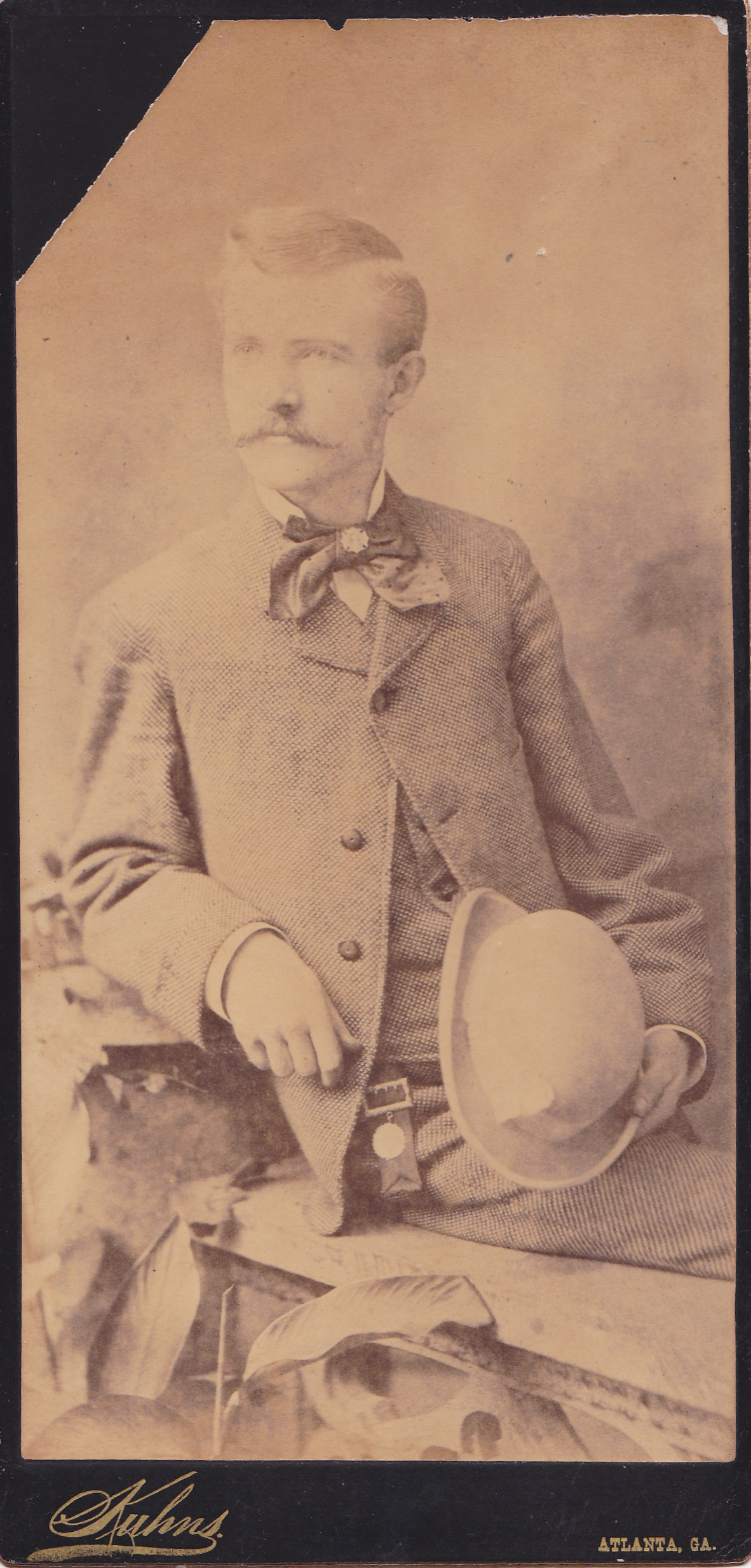
William Theodore Kuhns, was born in Tallahassee, Florida, on September 4, 1854, the second son of photographer William A. Kuhns and Sophia Steinbeck Kuhns. He was just over two years younger than his brother Julius, born in Mobile, Alabama, in July 1852. Two other brothers were born in Tallahassee, Henry in 1856, and Albert in 1858. Their only sister, Isabella, was also born in Tallahassee in in 1865.
Certainly their father began teaching Julius and William about photography as early as they could understand it. This education began in Tallahassee in 1868 for J.H. and in 1869 for W. T., according to an 1883 directory (Manufacturing and Mercantile Resource, under State of Georgia – City of Atlanta, page 294) but that education was certainly more in-depth after their move to Atlanta in 1870, when Julius was eighteen and William was sixteen. As of 1875, William T. was working as a clerk for his father. Julius had been working in his father’s studio as an artist before he began to work with him by 1876 as W. Kuhns and Son, then located at 37 Whitehall Street. William continued working with the firm and by 1879, he was listed in the Atlanta city directory as “Photographer, W. Kuhns and Son.” In 1881, the brothers Julius, as J.H. and W.T., were running the Kuhns studio in Atlanta at 33 1/2 Whitehhall Street.
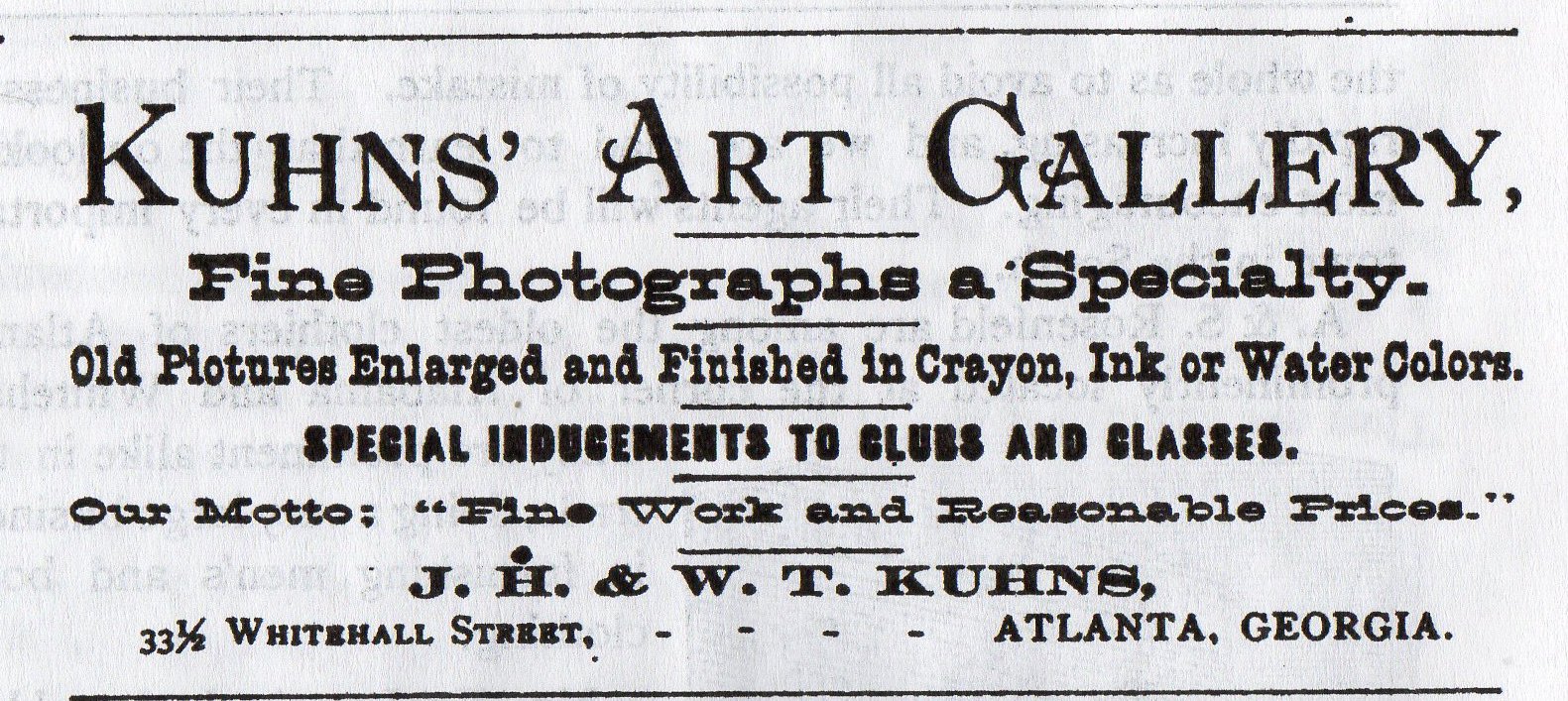
No longer the “tintyype gallery” of their father, J. H. and W.T. Kuhns’ Art Gallery advertised in spring 1883 “The Latest Styles of First-Class Photographs at Moderate Prices” and wrote that they had “introduced” the “Placque Panels & Photo Plaques” (Newnan Herald, April 10, 1883 pg. 2 col. 7, advertised to February 26, 1884). On page 3 of the same issue, is mentioned their “placques on china plates.” In addition to advertising in Newnan, Georgia in 1883, they also advertised in the Henry County Weekly the same year.
Their Plaques had been highlighted in the September 23, 1882, Trade Issue of The Atlanta Constitution (page 10, col. 5) under the title “Kuhns’s Placques – a Visit to the Great Art Gallery of Atlanta.” Mentioning they inherited “their father’s genius” the editor goes on to say that their placque pictures “are true-to-life, tasty, and unique in design.” Also discussed are their pictures of groups, including their photograph of members of The Gate City Guard, to which W. T. belonged. Their “portraits in ink” were also mentioned, “the Mssrs. Kuhns “having taken — the finest premium at the Cotton Exposition and in the North Georgia stock and fair association.”
Although he never held any Atlanta City offices, according to the Biographical Questionnaire filled out by his sister Isabelle E. Kuhns, in 1936 (for the Georgia State Archives,) William T. Kühns (she and he often used the umlaut) held many other organizational memberships. He was a member of the Young Men’s Library Association in 1877, was a Mason (Georgia Lodge 96, Atlanta), member of the Knights of Pythius (Knight Templer Couer DeLion, commandery no.4), and was a Yarab Shriner. He was also a Lieutenant in the Atlanta Rifles and is said to have won several of their shooting matches.
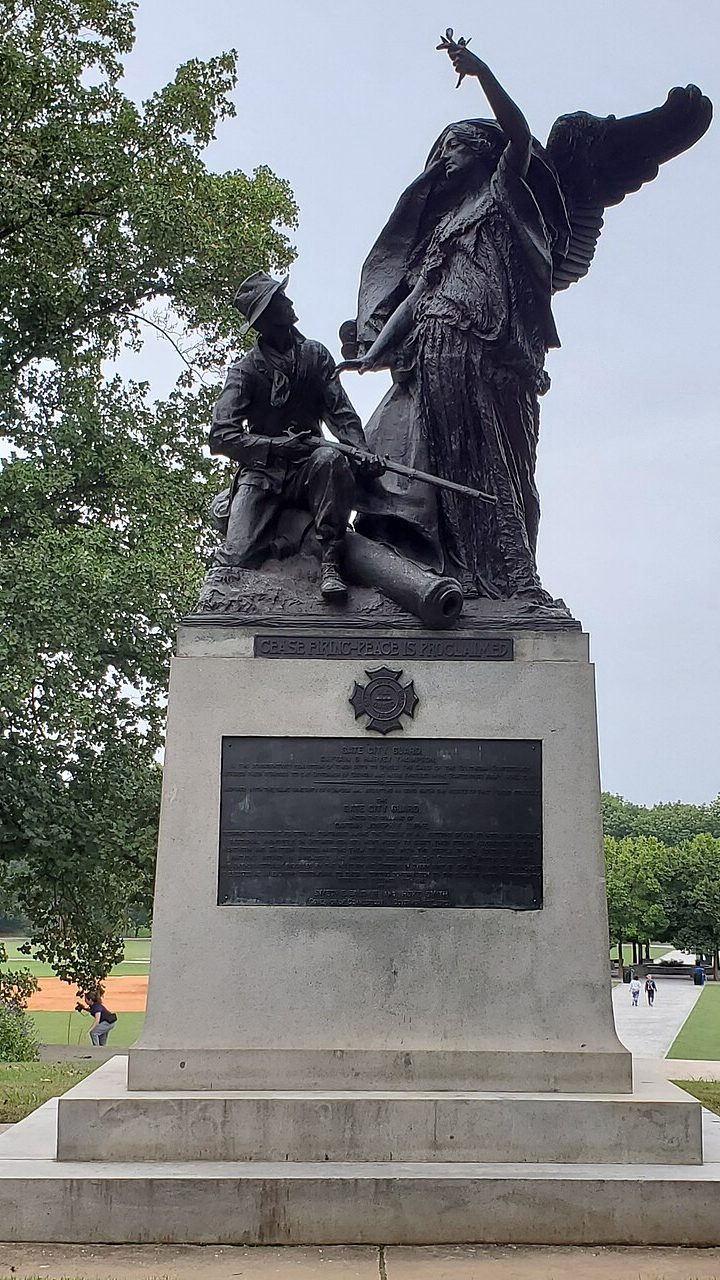
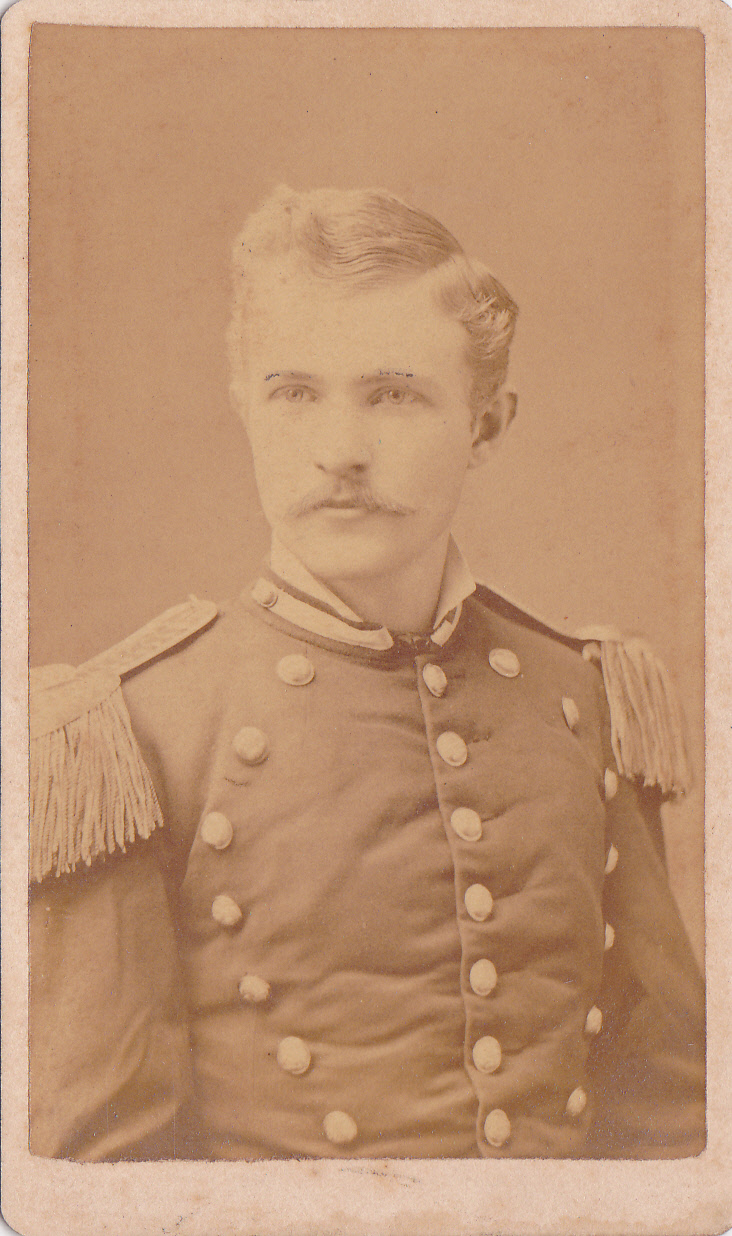
As a relatively new member of the The Old Guard battalion of the Gate City Guard he was part of a group accompanying Captain J. F. Burke on a good will tour through the northeast U.S., in 1879. This program was to cement friendship between the northern and southern states. It wasn’t until 1910 that the Guard commissioned a New York sculptor to design a monument to this Peace between them. In 1911 the sculpture was unveiled in Piedmont Park, and the mayors of Boston, Philadelphia, and Baltimore attended and military companies from Philadelphia, Maryland, Massachusetts and Connecticut marched. All marched together with the Guard down Peachtree Street (see https://en.wikipedia.org/wiki/Peace_Monument_(Atlanta) and https://exploregeorgia.org/atlanta/general/historic-sites-trails-tours/peace-monument-piedmont-park). W. T. Kuhns’s name was among those listed on the monument.
In 1885, his brother Julius was working as an itinerant photographer, sending negatives, etc. back to the Atlanta studio for finishing. During his absence, all references to “Kuhns, the photographer,” meant William T. Kuhns. On September 3, 1885, he publicized his photographs made of the grand procession and the laying of the corner stone at the new Capitol building which happened the day before (Atlanta Constitution p. 7, col. 3; Atlanta Journal p. 1, col. 2).
Made of of Georgia marble, it was 5 feet wide by 3 feet wide. The Masons laid it at what would be the northeast corner of the building, at Capitol and Hunter streets. Kuhns made “instantaneous” photographs including that of the Grand Master pronouncing the stone true and trusty. “A great many faces can be recognized,” in the photographs that were “gotten out by 3 o’clock.” They were on exhibit at Thornton’s book store, and at Lovejoy’s, and for sale at his gallery at 331/2 Whitehall “for 50 cents and $1 each, by mail post paid.” Both his advertisements in the Atlanta Constitution and the Atlanta Journal state that “this shows that Kuhns’ fascilities [sic] for promptness is unsurpassed. Views of houses, cattle, horses, etc., taken to order.” The Journal advert also mentioned readers should not “miss getting one of the photographs of the corner-stone made by Kuhns.”
In 1886 and 1887, W. T. Kuhns was advertising in Atlanta as well as outside the city. He published in Kennesaw (Kennesaw Route Gazette, July and August 1886,) where he advertised “an elegant lot of new scenery just received, and his 25 cent Bird’s Eye View of Atlanta,” and in Elijay (Courier, March – July, 1886 ) where he mentioned his “Medal and Diploma received at State Fair for Water Colors and Porcelains,” and in the North Georgia Times (Spring Place, GA; June 9, 1887), where he urged visitors to Atlanta to “see my State Fair Exhibit, which was awarded the only medal offered, and five diplomas.” He also advertised these awards and diplomas in the Atlanta newspapers.
According to the 1886 Atlanta city directory, William’s brother Charles (born in New York in 1869, prior to the Atlanta move) was then working for him, and sister Isabelle was his studio clerk dealing with the public. Charles M. Hollingsworth, who had worked for J.H and W. T. Kuhns, was now as a photo printer for W.T. Kuhns. In 1886, Julius, who was married, was back in Atlanta and sometimes in W. T.’s studio, but teaching at his Atlanta hone, and traveling. See my post on him at https://georgia-photographers.com/2026/02/07/first-son-photographer-j-h-kuhns/ In the 1888 Atlanta city directory, J. H. Kuhns was listed as a photographer at W. T. Kuhns.
Two articles on W. T. Kuhns and his studio, appeared in the Atlanta Constitution on July 24, 1887 (pg. 31, col. 2) and March 16, 1888 (pg. 4, col. 5) both probably written by Kuhns himself.
In July was “A Premium Taker – Mr. W. T. Kuhns, His Photographs and Premiums” described the studio walls “covered with beautiful work of all sizes…” including his minuettes, “the most popular picture in Atlanta.” About three hundred of these were shown in his window. Also “conspicuously displayed” in the gallery “are the various medals and diplomas.” Causing the editor to note Kuhns could be called “the premium taker.” His scenery is “all of the latest design and cannot be surpassed. — His apparatus is of the latest pattern….” Seventeen years in the business is stated, when the studio began in Atlanta in 1870 and William was sixteen.
In March was “Walks and Talks” regarding a Constitution “special from Athens” stating a photographer there “was the first to introduce the process” of photography by night. The editor was invited the the Kuhns’ studio “to see how he takes photographs by lightening —- the photographs are taken instantaneously, the light being what is known as a lightening flash.” Mr. Kuhns said he had been experimenting with this process since early January, and “claims this system — will be popular — will enable the artist to take pictures at the residence of his patrons as well as at his gallery by night.”
A more biographical article appeared about W. T. Kuhns in the May 1, 1889 Atlanta Journal (pg. 32, col. 1) stating “few artists are to be met with whose pictures surpass those of W. T. Kuhns…” and other flowery phrases. The history of the gallery is given, mentioning the Kuhns Bros, who he succeeded, although the term “Bros.” was not actually used in advertisements until many years later when it was in reference to William and his younger brother, Charles. It seems W. T. Kuhns “took all the photographs for the Journal’s Industrial Issue.” In column 2-3 of this article is an illustration of Kuhns, probably made from a photograph.
According to the 1889 and 1890 city directories, W. T. Kuhns was employing his brother Charles A. Kuhns as a principal photographer, Conrad S. Hart as a retoucher, and William Stephenson (1874-1941) as a printer. Stephenson went on to a long-time career as a photographer, primarily in Atlanta, and Conrad S. Hart went into business for himself as artist in Atlanta in 1890, although he soon moved on.
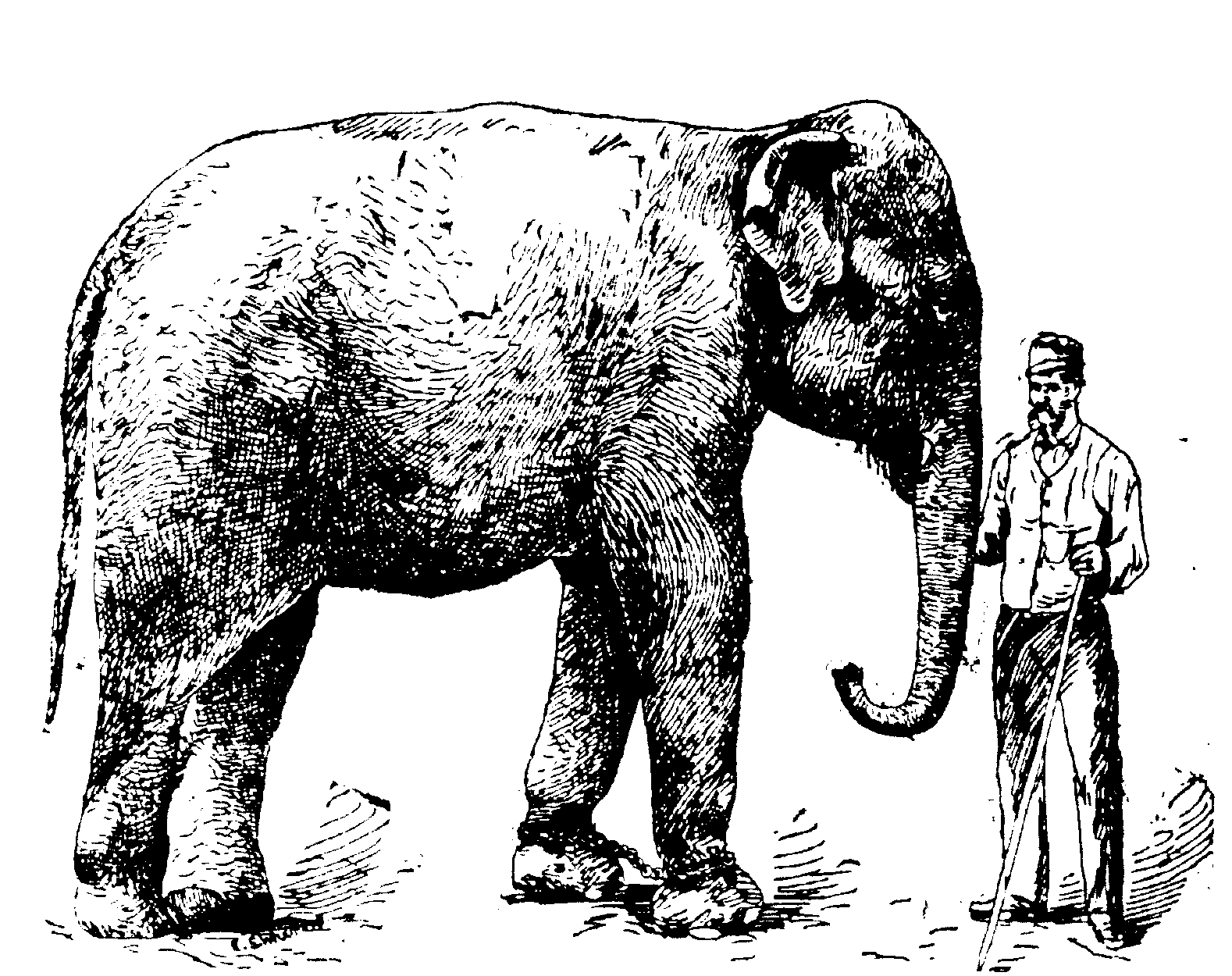
The excitement in Atlanta during the summer of 1890 was the purchase of an elephant “for the children of Atlanta.” The sale was handled by the Atlanta Constitution who had an Elephant Fund for citizens to contribute to purchase the animal. Once the animal was chosen and on its way to Atlanta, the newspaper asked the city’s children to choose a new name for it, sending along five cents a vote. The elephant arrived with the name”Nemo,” and sometime in August it was renamed Clio.
W. T. Kuhns “had the sole right for Nemo’s picture.” (Atlanta Constitution, August 10, 1890, pg. 17). “He took her in three different attitudes and will reproduce them all in one triple photograph, which he will sell for 15 cents. He will sell thousands on the day of the parade, and will give one-third of the proceeds to the elephant fund.” One of these photographs was reproduced in that issue by the Constitution‘s artist, Ernest Wilkinson.
That day the elephant Clio was in a procession going to Grant Park. watched by “thousands of people” sitting on seats and on the banks who wanted to see the elephant arrive. The procession went on to Gress Zoo, where a jaguar and a lion had also arrived and were put into cages made by the Atlanta Wire and Iron Works Company (Atlanta Constitution Aug. 10, 1890, pg.1). George Gress got the animals from a defunct circus, which he gave to the city of Atlanta., soon known as the Grant Park Zoo. With the 1935 addition of Asa Candler, Jr.’s private zoo, it evolved into what we now know as Zoo Atlanta. See https://zooatlanta.org/about/our-story/history/ for more information on the evolution of this zoo.
A few days later, Kuhns advertised these photographs with “four different views, cabinet size, then the four reduced on cabinet size; either kind 15c,” and he also sold “a large size suited for framing, for 50c,” at his gallery at 33 1/2 Whitehall (Atlanta Constitution, August 12, 1890, pg. 3).
At the end of the month, W. T. Kuhns was still advertising “unique pictures of Clio, the children’s elephant” for sale. These were the same photos he made of “Nemo” but the pictures were now on sale at the Park “for only 15 cents,” but still one-third of the sales would go to the elephant fund. (Atlanta Constitution, Aug. 30, 1890, pg. 4.
I hope this introduction to William T. Kuhns’ work to 1890, makes you eager to learn more about him. Part two, 1891-1901, on photographer W. T. Kuhns will appear this winter.
© E. Lee Eltzroth and Hunting & Gathering, 2026. Unauthorized use and/or duplication of this material, including photographs, without written permission from this blog’s author, is prohibited. With permission, excerpts and links may be used, provided that full and clear credit is given to E. Lee Eltzroth and Hunting & Gathering, with appropriate and specific direction to the original content.


