
This post, concentrating on the first son born into of a family of photographers, is the second of my four-part series on the Kuhns family. This image of J. H. Kuhns is a carte-de-visite probably made by his father in about 1877, when they were working together. He was born in 1852, in Mobile, Alabama, to August William and Sophia Kuhns.
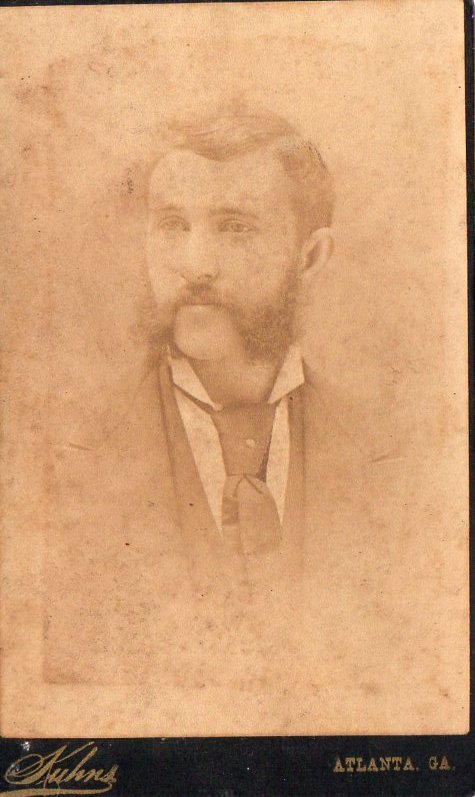
Julius Henry Kuhns was less than two years old when his parents moved to Tallahassee, Florida, where his brothers William, Henry, Albert, and his sister Isabella were born between 1854 and 1865. His last brother, Charles was born in New York in 1869, but raised in Atlanta. By Autumn 1870, the family was in Atlanta, Georgia, where William Kuhns established the photography business that would last over fifty years, in one form or another, in the Atlanta area. See more at my first post https://georgia-photographers.com/2025/11/12/photographer-father-william-a-kuhns/
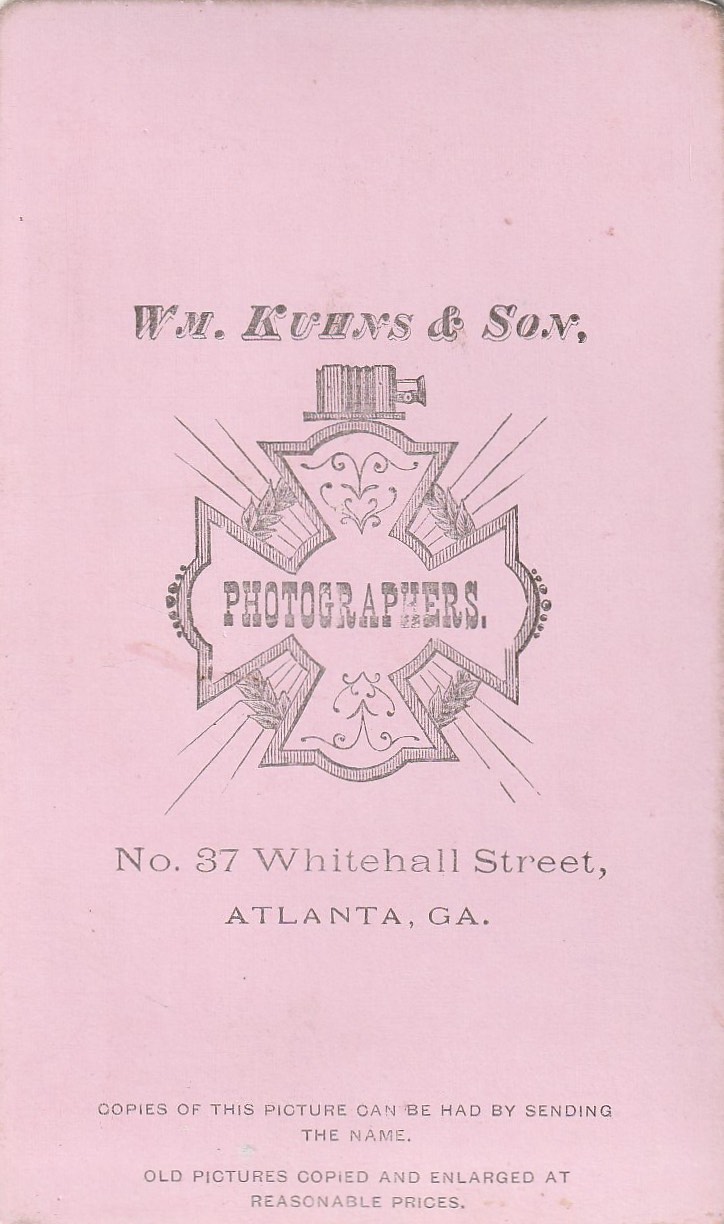
As of 1876, Julius Kuhns, who had been an artist for his father’s business since 1874, officially joined the firm to be known as Wm. Kuhns & Son, in the Photographic and Ferrotype Gallery located at 37 Whitehall Street. His brother William, two years his junior, who had been a clerk for the Kuhns gallery by 1875, was given more responsibility in their firm.
As early as 1875, before Julius was officially part of Kuhns & Son, he was working away from Atlanta as an itinerant artist-photographer. From July 29 to August 19, 1875, he advertised in the Newnan Herald and the Newnan Advertiser that he was in his “Large Tent” Gallery in back of the Baptist Church in order to provide “all an opportunity to obtain well-executed likenesses of themselves and friends.” He was to leave Newnan on August 25th.
In January 1878, Julius was again working away from Atlanta since his brother was now involved in the photography business, and it was perhaps easier to get away. He was in Conyers in January, but moved on to Covington. He would return to those cities in 1885.
By January 1880, Wm. Kuhns & Son brought in “noted first-class Photographer” Mr. L. H. Stoddard, of Ansoina, Connecticut, as another photographer to work for them (Atlanta Constitution Jan. 20, 1880, pg.4, col. 7), and exhibited some of that photographer’s work at Philips & Crew, a business also known as a producer of stereo views. Stoddard is the same photographer who made a cart-de-visite portrait of William Kuhns, a few years earlier.
In May 1881, J.H. Kuhns was a member of Atlanta’s Gate City Guard that accompanied Governor Colquitt to a meeting in Nashville, Tennessee (Atlanta Constitution May 24, 1881 pg.4; William, also a member, was not on this trip). On December 27, 1881, Julius married Louise Harris, and the wedding was announced in the Atlanta Constitution on Dec. 29th.
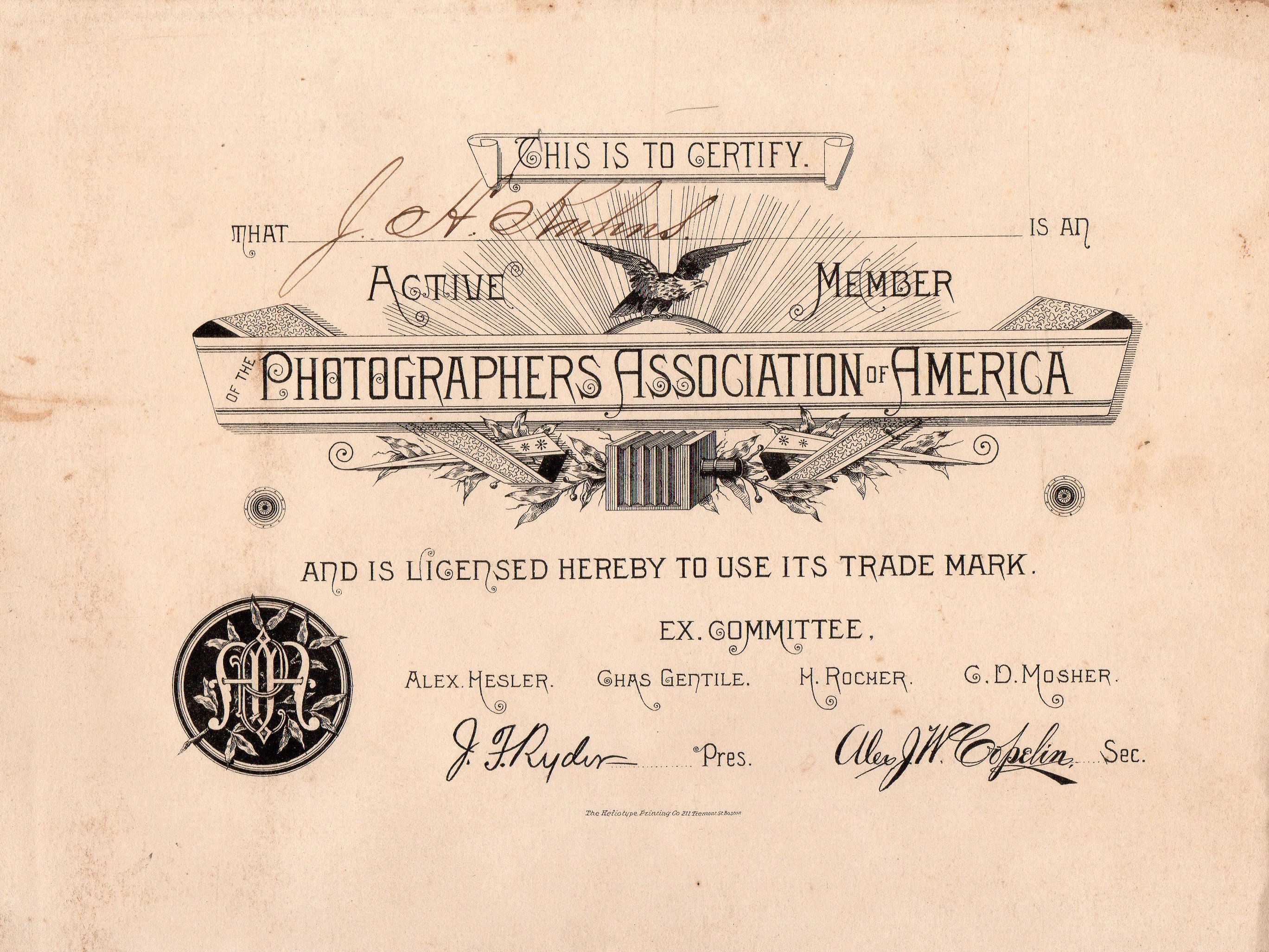
Sometime in the very early 1880s, Julius attended the meeting of the re-formed Photographers Association of America. J. H. Kuhns’s undated certificate as an Active Member is signed by the very first Association officers: president J.F. Ryder, secretary Alex J.W. Copelin, and the members of the executive committee, Alex Mesler, Charles Gentile, M. Rocher, and C.D. Mosher. These names are still recognizable names in the history of American photography.
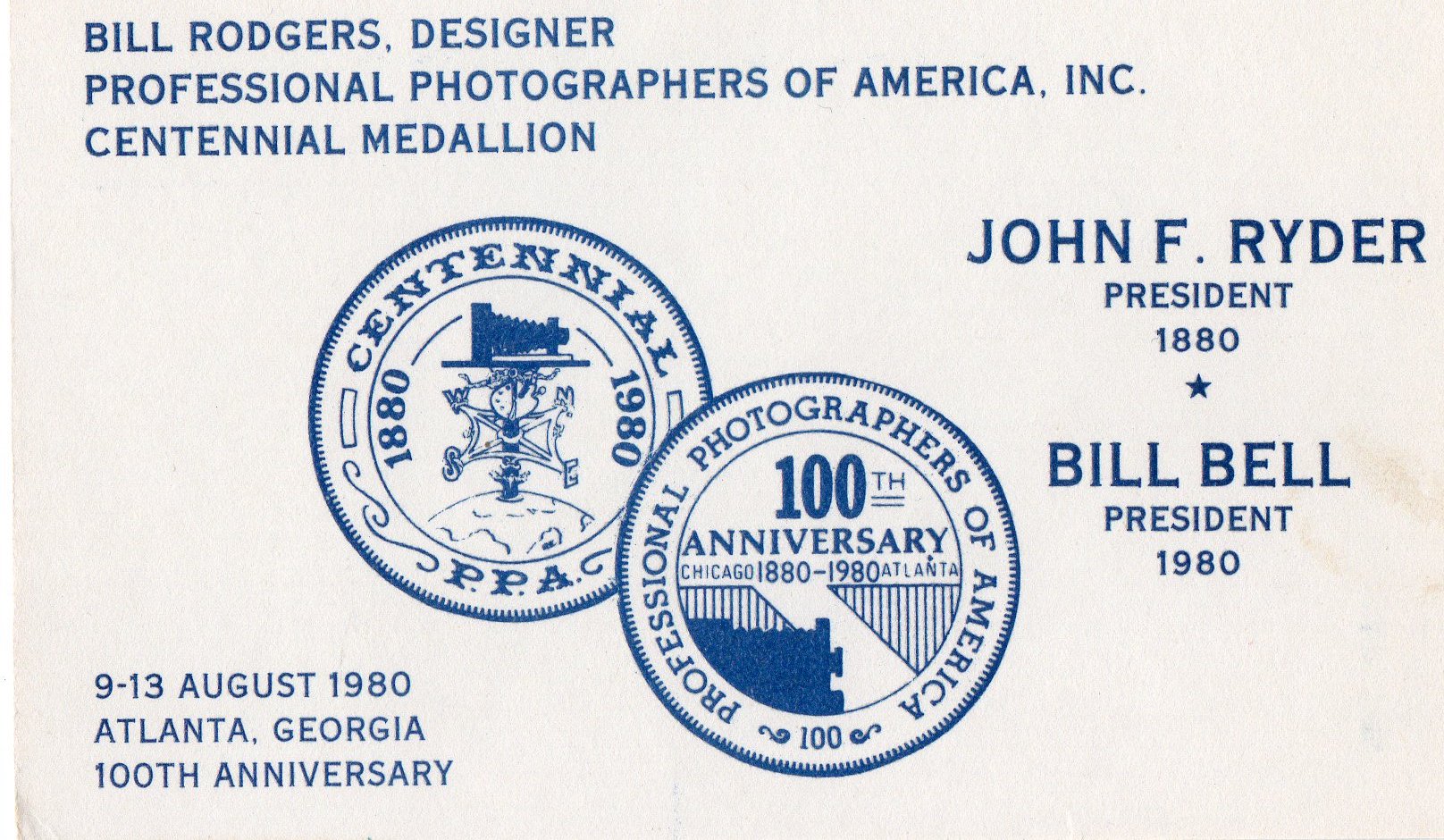
The organization was one-hundred years old in 1980, when their meeting was held in Atlanta. Its name changed in 1957 to the Professional Photographers of America, but the gentleman who designed a centennial medallion for that 1980 event failed to recognize that name or change of initials, from PAA to PPA.
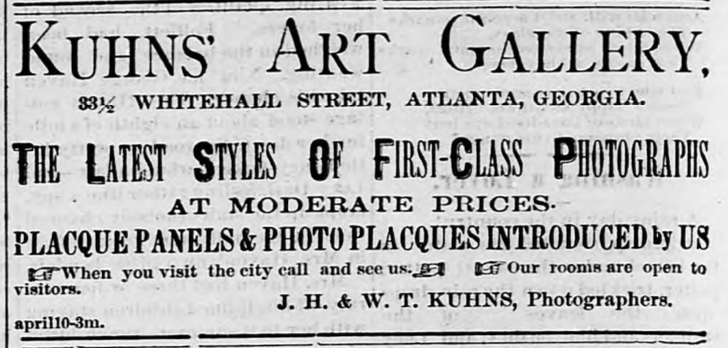
By 1881, the photography business was run only by J. H. and W.T. Kuhns. In 1882 two significant items appeared in the Atlanta Constitution that point to the earlier success of the brothers’ photographic firm. Although Julius was an artist as well as a photographer, they hired Miss Katie Thomas to color photographs in watercolor or India ink, although I do not think she worked in their studio, but in her own (Jan. 15, 1882, page 8, col. 2). In a separate business section of the newspaper of September 23, 1882 (page 10, col. 5), was a long article with the heading Kuhns’s Placques — A Visit to the Great Art Gallery of Atlanta. This piece described the history of the firm and the brothers’ taking it over. Cited as “One of the most widely known places in the gate city,” where “their placque pictures — are true to life, tasty and unique in design.” It continues to describe their group pictures, portraits in India Ink, premiums won at the 1881 Cotton Exposition and at the North Georgia fair, closing with “The Messrs. Kuhn [no S] deserve the wide patronage they have received…”
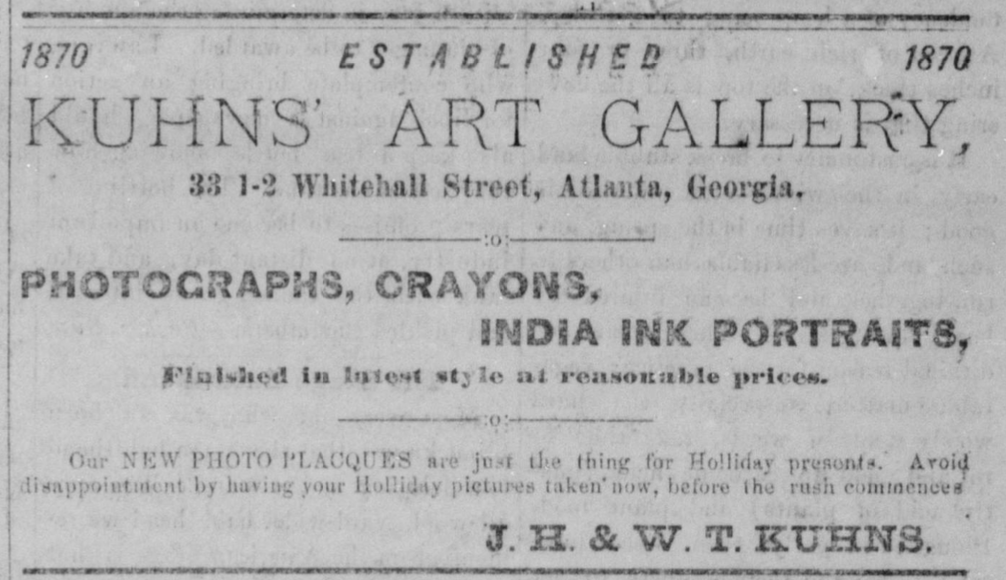
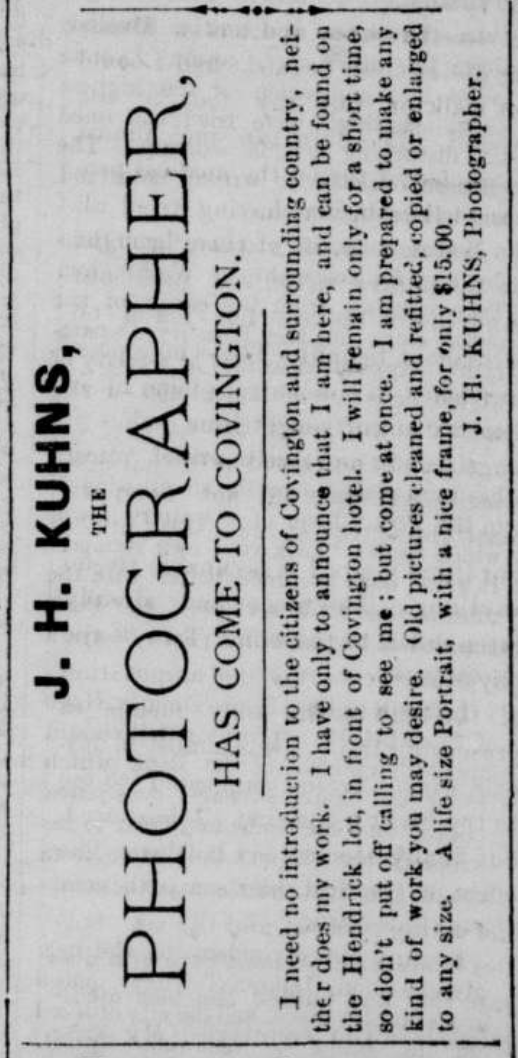
In 1883, as all the photographers in the family also worked as itinerants, several advertisements were placed by J.H. & W.T. Kuhns in small-town Georgia newspapers. By 1885, when things were well-in-hand it the Atlanta gallery, J. H. Kuhns, “the photographic artist” returned to Covington to work in mid-April “for a few weeks.” He returned to Atlanta before coming back to Covington to work in June, where he made photographs “at regular hard time prices” (Covington Star, pg. 3 April 1, 1885, June 10 and 17, and July 8). On June 10 and 17, in an advertisement that was printed vertically, he offered “a life-size portrait, with a nice frame, for only $15”. He left for Atlanta by July 8th.
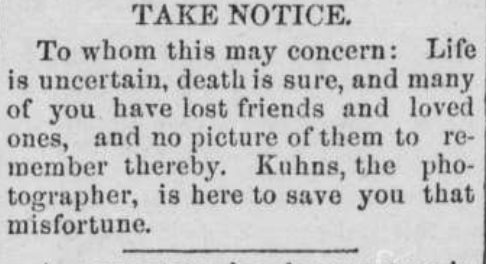
In early November 1885, he was in Conyers where he placed four different ads in columns 3, 4, and 6 of the same issue of The Solid South on November 7th. He would offer to teach crayon drawing, he offered ferrotypes “or any kind of picture you want” including water color, ink or crayon for only $15, he posted his thoughts on why one must have a photograph made, and he would enlarge or copy “fading” pictures of loved ones.
In 1889, the Kennesaw Gazette published an article about J. H. Kuhns, who “gives his whole attention to scenic photography,” and who is “one of the best professional photographers in the south.” The reporter (or Kuhns himself?) goes on to say that he “has photographed the whole city of Atlanta from the dome of the capitol,” all streets, all buildings of note, quarrying, mining, and manufacturing enterprise within a hundred miles “outside and inside,” family groups,”any inside pictures at night by the flash-light,” horses, cattle, pet stock. “There is not a steeple in Atlanta he has not pointed his camera from.” Noted is that one view shows “grand old Kennesaw, 20 miles away, flanked by Lost and Pine mountains, in the horizon.” His recent photo of “Georgia’s new capitol. He has the finest picture — 17 x 20 inches — of the main front.” His smaller pictures of that building and inside views were “made for state authorities.” These views could be purchased from the photographer “very reasonably.” (April 1, 1889, pg. 5, col. 3-4)
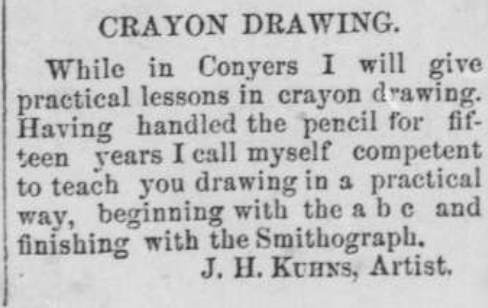
By 1886, W.T. Kuhns was handling the Atlanta business, and J.H. Kuhns worked in the Whitehall studio when he was in Atlanta through 1898. While in Atlanta he also taught Crayon Drawing at his home on Luckie Street. He advertised in the Atlanta Journal that he had opened a night school for men to receive “a practical and systematic instruction in landscape and portrait crayon drawing” (July 6, 1886, pg. 4, col. 4). But he also continued to work in other areas of the state.
Along with photographer Hugh B. Adams, J. H. Kuhns photographed the members of the International Convention of Car Accountants. They were meeting at Kennesaw in May 1887, and were photographed “just before going up the hill.” The news columnist thought that the 17×20 inch photo “is taken probably on the most historic ground on which any one shown therein will ever stand again ‘to have his pictur’ took’.” (Kennesaw Gazette, May 1, 1887, pg. 4, col. 4)
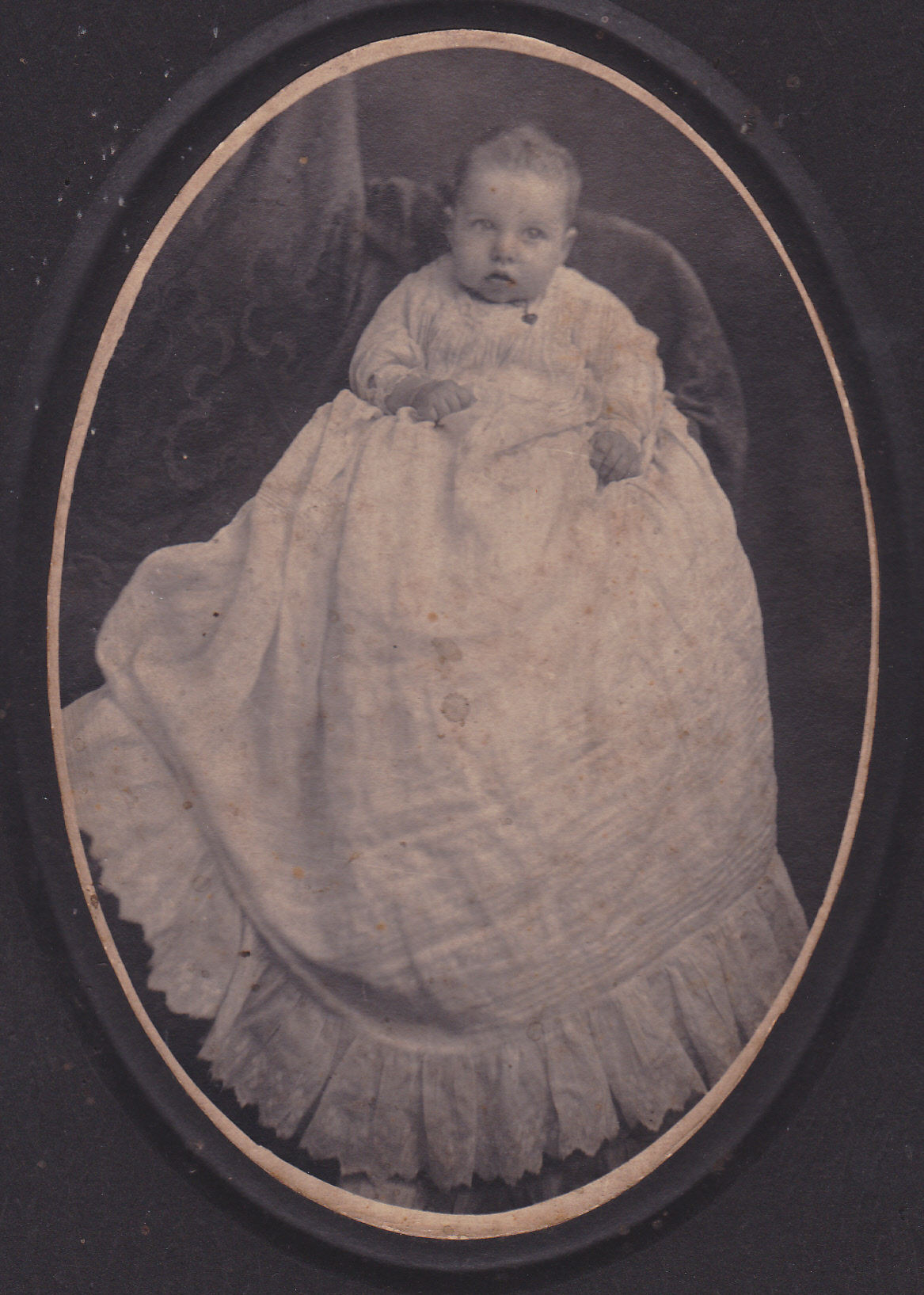
In the fall of 1889, J. H. Kuhns was traveling again, and with a son born in 1888, he certainly needed to supplement his income. In September, and again in October, he traveled to Indian Springs to make photographs. He advertised in the Middle Georgia Argus (24 Sept. pg. 2, col. 5 and Oct. 8, pg.3, col. 3) that his representative, T. R. Latham would work for him there in September (although the citizens hoped to “induce Mr. Kuhns to come to Jackson as he is one of the best artist in the country”) and he did come there briefly. In October, J.H. Kuhns came to Jackson on a Thursday and Friday where he promised to “do Atlanta work at Atlanta prices,” and Mr. Latham canvased the town for him to take orders.
In early 1892, William T.Kuhns went to work in Albany, in Dougherty County, for a few years, and J. H. Kuhns took over running the Whitehall Street studio.
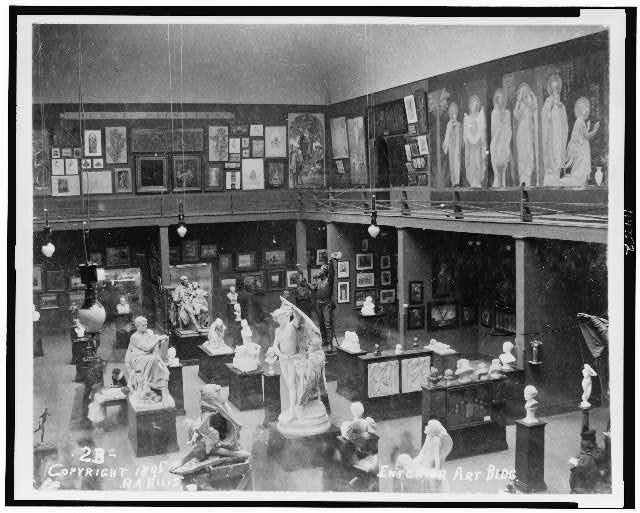
The 1895 Cotton States Exposition was an exciting event considered a world’s fair, and Julius Kuhns served on the Photographers Committee. When William returned to Atlanta by early 1896, J. H. Kuhns continued to work for him there for another few years.
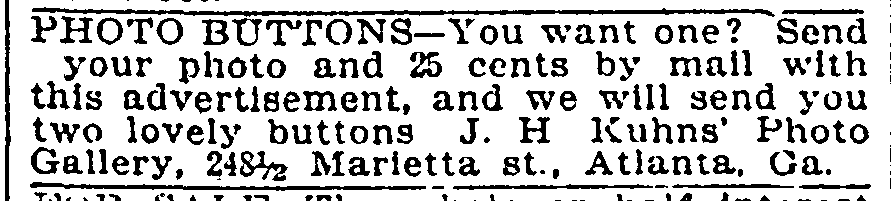
In 1899, he established his 248 1/2 Marietta Street studio over the family’s rental home, and he kept that studio through 1913. Although it is often assumed this was an “extension” of the Whitehall Street gallery, W.T. Kuhns and J.H. Kuhns advertised very separately under their own names during this period.
In the first decade of the new century, J. H. Kuhns’s cut line appeared under many photographs printed by the Atlanta Constitution.
By 1904, Julius H. Kuhn’s Marietta street studio was also called Kuhns Photo Studio (Business Directory of Georgia, 1904-1905). In 1908, his Marietta street gallery was the location of the Moore Memorial Church’s “Hallowe’en Social.” That was his church, and as one of the original sixteen founders in March 1874, and a deacon of what was then the Third Presbyterian Church, he remained very active and had been made an officer of that church by 1889 (Atlanta Daily Herald, Mach 5, 1874 pg.4, col. 1; Atlanta Journal, April 8, 1899, p19, col. 3 and Oct. 30, 1908 pg.13).
As of the 1910 census, Julius’s family had moved to Harris St. (and would move to Inman Park by 1913), but he kept his photo studio at 248 1/2 Marietta street. The year 1910 was when his wife Louise was also cited as a photographer (as Marie L) by the census taker. It is quite likely she was assisting her husband in his photography studio, possibly for a few years. But the 1913 Atlanta city directory is the last time Julius is listed with his own studio. In June of that year, Julius and Louise’s twenty-five year old son Dwight Harris Kuhns died after a short illness. Louise Kuhns passed away the following February, in 1914.
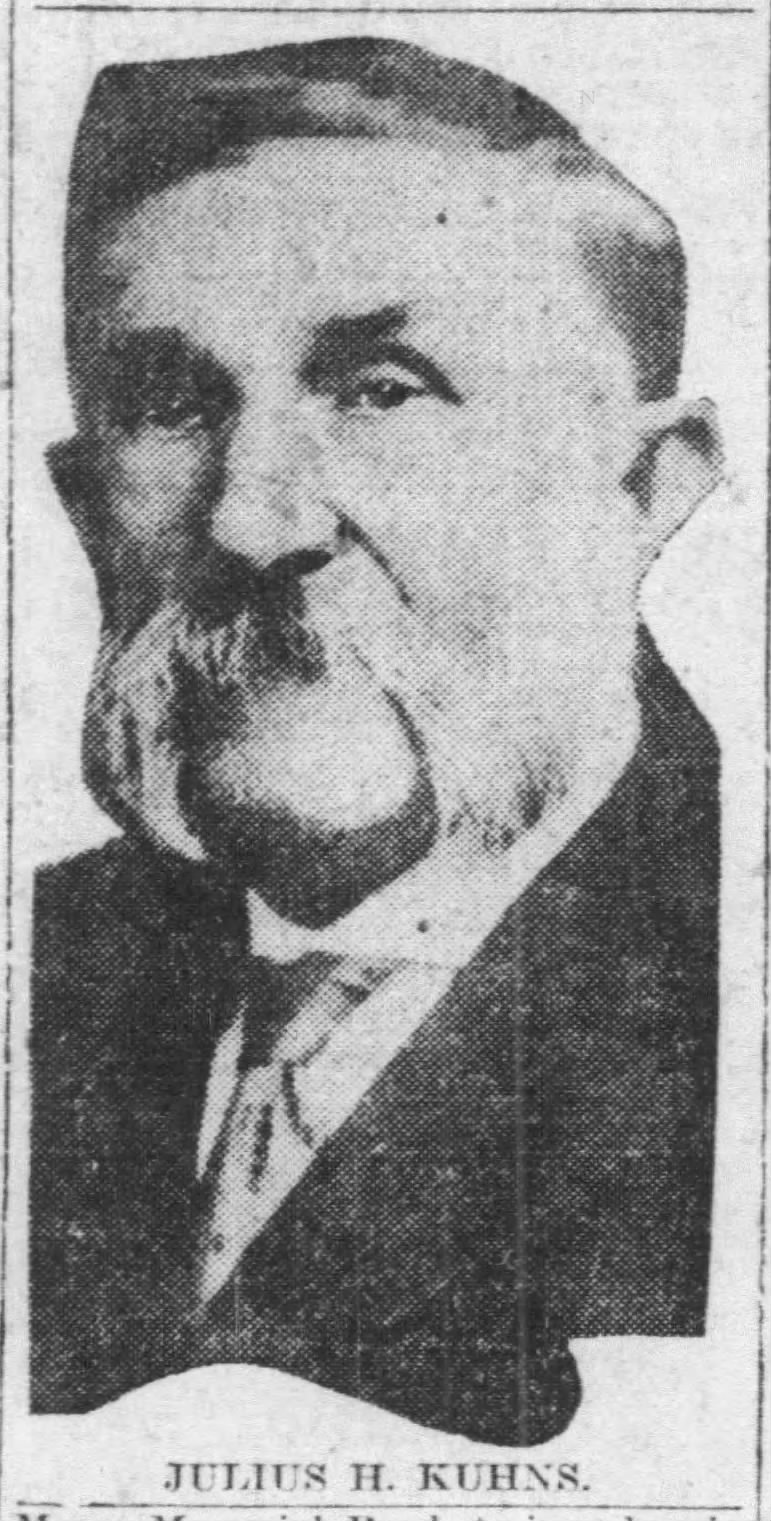
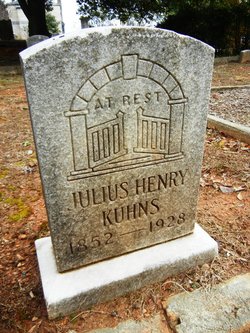
Julius began working again at W. T. Kuhns, and he is listed in the city directory as a photo printer in 1915. By 1920, the city directory listed him as a photographer but he was living in College Park with his daughter Julia Sprinkle, married to John Harvey Sprinkle. He retired in about 1924, and died at his daughter’s home on December 24, 1928, at age seventy-six.
He was buried at Oakland Cemetery in Atlanta, where his father, mother, son, wife, and his brother Albert, who died in November 1928, were also buried. His brother Henry, in a poultry business with Albert, died a few days after Julius and also rests at Oakland. All three of his photographer brothers and his sister, who had worked for the studios, outlived Julius.
© E. Lee Eltzroth and Hunting & Gathering, 2026. Unauthorized use and/or duplication of this material, including photographs, without written permission from this blog’s author, is prohibited. With permission, excerpts and links may be used, provided that full and clear credit is given to E. Lee Eltzroth and Hunting & Gathering, with appropriate and specific direction to the original content.


 Hunting and Gathering
Was there a connection between the Kuhns and the Van Stavorens? They seem to have come to Atlanta around the same time.
Sorry if I did not reply to this, I was out of town. I don’t think there was a real connection, but when I am back to my database I will give you some bio data on both of them.
I love getting these emails and learning about a unique part of Georgia history. Thank you for your amazing efforts!
Thank you!
Thanks for reading and glad you are enjoying them!