August Wilhelm Kühns arrived in the port of New Orleans, United States, on November 17, 1849 on the ship Captain Tom, which had departed from Hamburg, Germany [Prussia]. This was a relatively new brig (two-masted sailing ship) first launched in 1845, and used for transporting immigrants. Born in September 1824, in the town of Hohennauen, Prussia, not far from Berlin, in the district of Brandenburg, Wilhelm Kühns was a son of the Hohennauen bürgermeister (per Atlanta History Center). He is listed on the ship’s passenger list as “Wm. Kuhns,” a “wheelright,” which seems unusual for a future photographer.

A young woman named Sophia Steinbe[ck] was also on the Captain Tom, traveling with an aunt and uncle surnamed Witte. It is unknown whether William and Sophia knew each other prior to this voyage, but they certainly knew one another by the time they docked in New Orleans. Sophia’s aunt had brother, a tailor in Mobile, Alabama, the state’s largest city, and they all found their way there from New Orleans.
Known only by William or Wm. Kuhns as long as he was working as a photographer, his given name as “August Wilhelm” Kuhns is found in both the Mobile, Alabama records for their license application (July 28, 1851) and marriage record (July 31, 1851) when he and Sophia (Sophie) Steinbeck married (FamilySearch). He is listed as William A. Kuhns in some later records, possibly because their second son William Theodore Kuhns, used his initial and was known as William T. Kuhns.
While the couple were still in Mobile, Alabama, their first son, Julius Henry, was born in July 1852. By January 1854, the young Kuhns family had moved to Tallahassee, Florida, so that William could become a partner to photographer James Baily, who “permanently located himself” in Tallahassee “over Barnard’s Drug Store,” in December 1853. Their partnership became known as Kuhns & Baily.
William Kuhns may have known something of photography prior to his arrival in the United States, or he may have learned about it in New Orleans, a city with both itinerant and well-established photographers by 1850. In Tallahassee, in the Florida & Journal newspaper on 14 January, the partners advertised their partnership and that they both had “long experience in the art, and making it their constant study.” They were taking “miniatures of all sizes and styles of the art, and warranted not to fade” every day but Sunday. In their “daguerreian sky light gallery” in Baily’s original location, they also offered “instructions to those desirous of acquiring a knowledge of the art,” and sold Daguerreian materials, including plates, cameras, cases, and frames “at 10 per cent above New York prices.” Did they mean “only ten per cent above”?
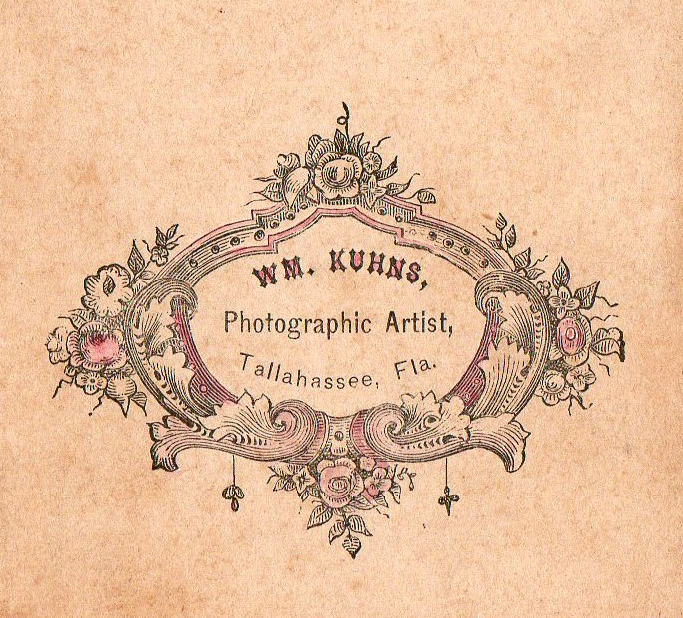

The second Kuhns son, William Theodore, was born in Tallahassee on September 4, 1854. It appears the partnership with James Baily was over before March 1856, when William Kuhns, now the father of two, noted in the Florida & Journal on 22 March, that he would leave in a few weeks, and would return in the fall. The third son, Henry August, was born in Tallahassee to Sophia and William Kuhns in September 1856. In an advertisement in the Floridian on 20 December 1856, William offered “beautiful colored Ambrotypes,” but urged clients to “call early,” as his “engagements elsewhere will soon cause him to leave.” William Kuhns had to hustle to feed his growing family. Other than Quincy, northwest of Tallahassee, I have not yet documented other Florida cities he visited as a photographer (see floridaMemory.com State Archives of Florida photographs).
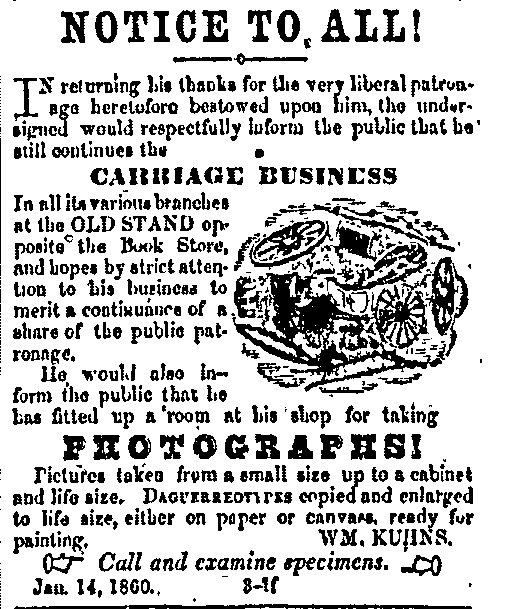
In July 1858, William Kuhns returned to his trade as a wheelwright and his first advertisement for his Carriage Shop, next to Brokaw’s Livery Stables, appeared on 10 July in the Florida & Journal. On December 30, 1858, the couple’s fourth son, Albert Frederick, was born.
By January 14, 1860, he was advertising his “new” carriage business as well as his photography business in the newspaper. He had “fitted up a room” in the carriage shop where he made photographs on paper, and copied and enlarged daguerreotypes. The Kuhns family appears on the July 1860 U.S. Federal Census in Tallahassee, Florida, wherein William is cited as “carriage maker.”
By 1859, competition from photographers Sache & Potter, who also seem to have been itinerants, began. Those photographers returned to Tallahassee periodically through 1861, but only “Wm. Kuhn” appeared in the Feb. 19, 1867 Business Directory of the Floridian. The couple’s only daughter, Isabella, was born in Tallahassee in September 1865.
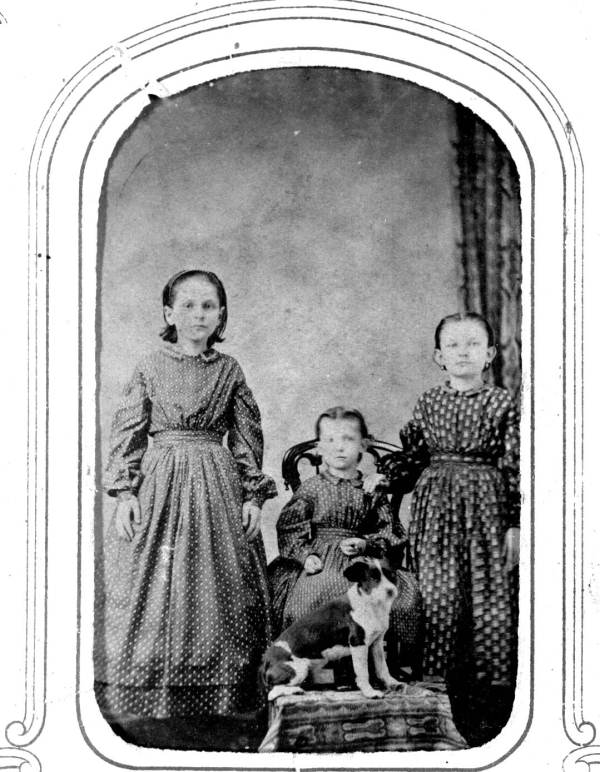
As of 1871, photographers Robert & Cole advertised as located “at Kuhns old gallery.” In February 1874, Wm. Kuhns “announced his coming to Tallahassee to his old friends” that he was on a visit and
“prepared with improved apparatus” would take “photographs, ferrotypes, & etc.” on a lot opposite the state bank (Floridian of 10 and 17 February). There was no mention of the fact that he and his family were now living in Atlanta, Georgia, where they re-located as of October 1870.
But the couple’s fifth son, Charles August (Augustus), was born in New York on 19 December 1869. A William Kuhns found on the 1870 Federal Census in New York City has no family listed. Other than finding his birth date and parents on Charles A. Kuhns’s May 1937 application for his social security number, I have yet to find other documentation of his New York birth. But they were certainly in the New England area as William A. Kuhns had his photograph made by a Connecticut photographer in about 1869.
Apparently, after a return from the New England states, the family chose Atlanta as their new home and were there by October 1870. William Kuhns first appears in Hanleiter’s Atlanta city directory in 1871, when he is listed at 13 Whitehall St. under Ambrotypes, and not under the listing of Photographers. In the individual listings, “Wm. Kuhn [sic]” is listed as an artist, on Whitehall.
There is a often confusion between William Kuhns (sometimes without the S) and F [Franklin “Frank”] Kuhn (never an S). Franklin Kuhn (1829-1908) had been working in Atlanta since July 1865, and had a well-known gallery that went by various names (including his Pioneer Gallery), until he became a partner to Merton Smith in about 1869. That partnership ended in August of 1871, shortly after the publication of the city directory where they are listed at 27 Whitehall. In Hanleiter’s 1872 city directory, Merton Smith is partner to C.W. Motes at the same location. By 1873, F. Kuhn was in Baltimore where he had worked in the 1850s, and moved to Texas by 1882, where he ended his career. One “Kuhn” left Atlanta at almost the same time another “Kuhn” arrived.
In Hanleiter’s 1872 Atlanta city directory, “William Kuhn” is listed only within the listing of individuals, as an Artist, on Whitehall St. In Beesley’s 1874 Atlanta city directory, among the listing of three Photographers is Kuhn (still no S), William, at 14 Whitehall. In that same edition, Julius H. Kuhns is listed as an artist, and “William T. Kuhn” is listed as a student, but all the family live at 62 Walker Street. The family members are listed as Kuhns within the individual lists.
In 1875, Wiliam A. Kuhns is listed in the Atlanta city directory, again under Ferroypes, and in the individual lists, William T. Kuhns is listed as a clerk in his father’s ferrotype gallery, which is now at 14 1/2 Whitehall, but Julius H. Kuhns is unlisted, and was working outside the city. The family lived at 185 Luckie Street, where they lived many years.
In about 1875, William Kuhns made a tintype studio portrait of Alexander H. Stephens’ servant, and former slave, Harry Stephens (held in a private collection). This would have been taken while Alexander Stephens (d. 1883), of Liberty Hall, Crawfordville, was serving in the U.S. House of Representatives. He was previously vice president of the Confederacy, and later, 50th Governor of the state. This tintype was used in about 1890 in a composite portrait photograph of Harry (died 1881), and his wife Eliza (d. 1920), Stephens’s former housekeeper. The copy tintype image is placed in front of Eliza’s more recent photograph, with her lace collar and bonnet enhanced. The photograph may have been made at the request of Eliza, or one of their five children, and was possibly made by the Kuhns Gallery.
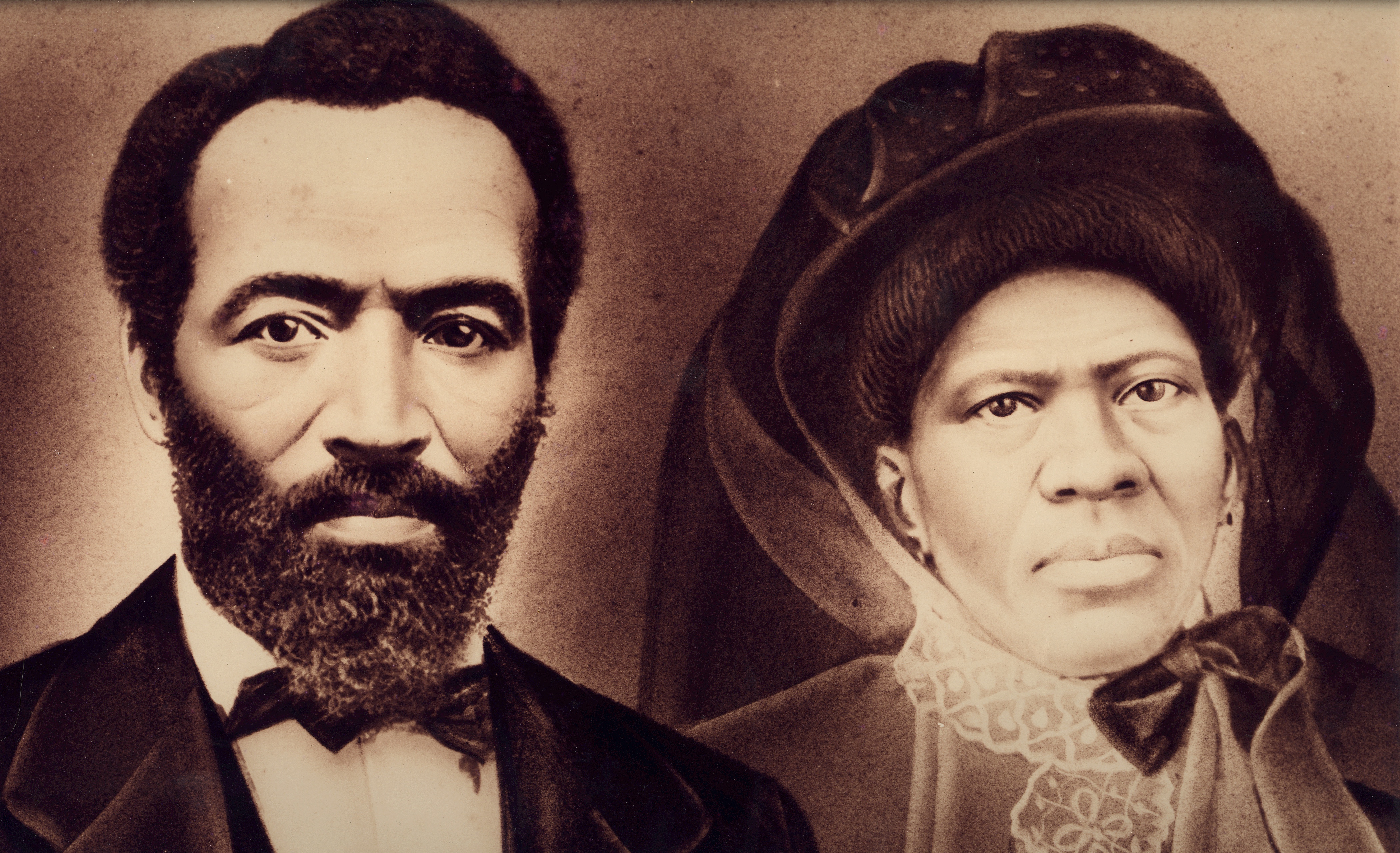
Harry purchased a small home from his former master in 1872, for an annual payment, and he bought 17 acres from him in 1877. The house stayed in Harry and Eliza’s family until the death of their daughter, Dora, in 1931. (Georgia Department of Natural Resources, Historic Preservation Section. Martha F. Norwood, Liberty Hall: Taliaferro County, Georgia: A History of the Structures Known as Liberty Hall and Their Owners From 1827 to the Present, 1977).
In the 1876 directory, Kuhn, Wm. & Son are listed for the first time, in a list of “Photograph Galleries” along with seven others. Their gallery was at 37 Whitehall. Under the individual lists Kuhns, “Wm. & Son” (Wm. & Julius H.) are listed as a photograph & ferrotype gallery, 37 Whitehall, and with each name is noted the Luckie street address. William is abbreviated as Wm., but William T. Kuhns is unlisted.
An 1877 advertisement for Kuhns & Son appeared in the Atlanta Constitution on 24 January (first in on 21 Jan.) on page 4, headed “Photographs – Kuhns & Son are making first class Photographs at $3.00 per dozen. Call and examine their work, 37 Whitehall street.” It is known that they took and sold stereographic views, but as yet, I have none in my collection.
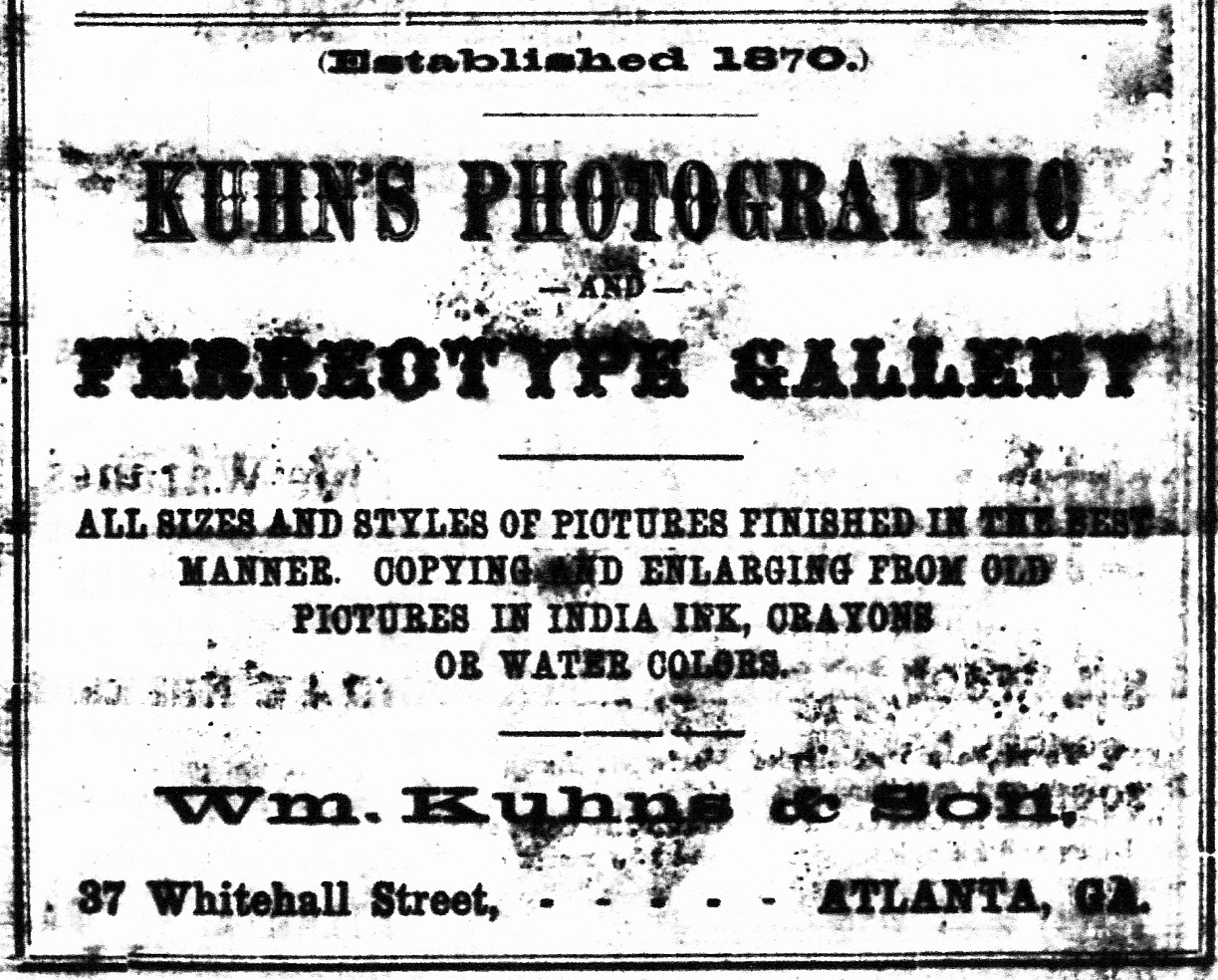
In Sholes’ 1877 city directory listing under Photographers, Kuhns & Son are listed in all caps and in bold print as KUHNS & SON. In addition, they had an advertisement in the preliminary advertisements pages (pg.2) for KUHN’S PHOTOGRAPHIC & FERROTYPE GALLERY with Kuhn apostrophe S as their name and stating it was Established 1870. In the individual lists, Julius H. and William are listed as W. Kuhns & Son, and W.T. Kuhns is listed as “with W. Kuhns & Son”. Both sons are listed as boarding at W. Kuhns’s Luckie Street home. In Sholes’ 1878 Atlanta city directory Kuhns & Son, 37 Whitehall, are listed again under Photographers, but not in bold. The individual lists show them still living on Luckie street, and William T. is listed as still “with” W. Kuhns & Son.
By 1879, Kuhns & Son were finally located at 33 1/2 Whitehall, which remained the Kuhns studio location for 48 years, until about 1927. C.W. Motes (1837-1919), a prominent Atlanta photographer, was located at 32 Whitehall, so he and the Kuhns were neighbors. The directory’s individuals list show that for the very first time, William T. Kuhns is listed as a photographer with W. Kuhns & Son.
In 1880, the Kuhns family appears in the federal census as a family of four, William and Sophia, with Isabella and Charles still living at home. Sons Henry and Albert lived in rural Fulton County and had a farm. Neither William T. or Julius H. is seen on this census, but both are listed as with Kuhns & Son, photographers in the 1880 city directory, and noted as living with the family on Luckie street.
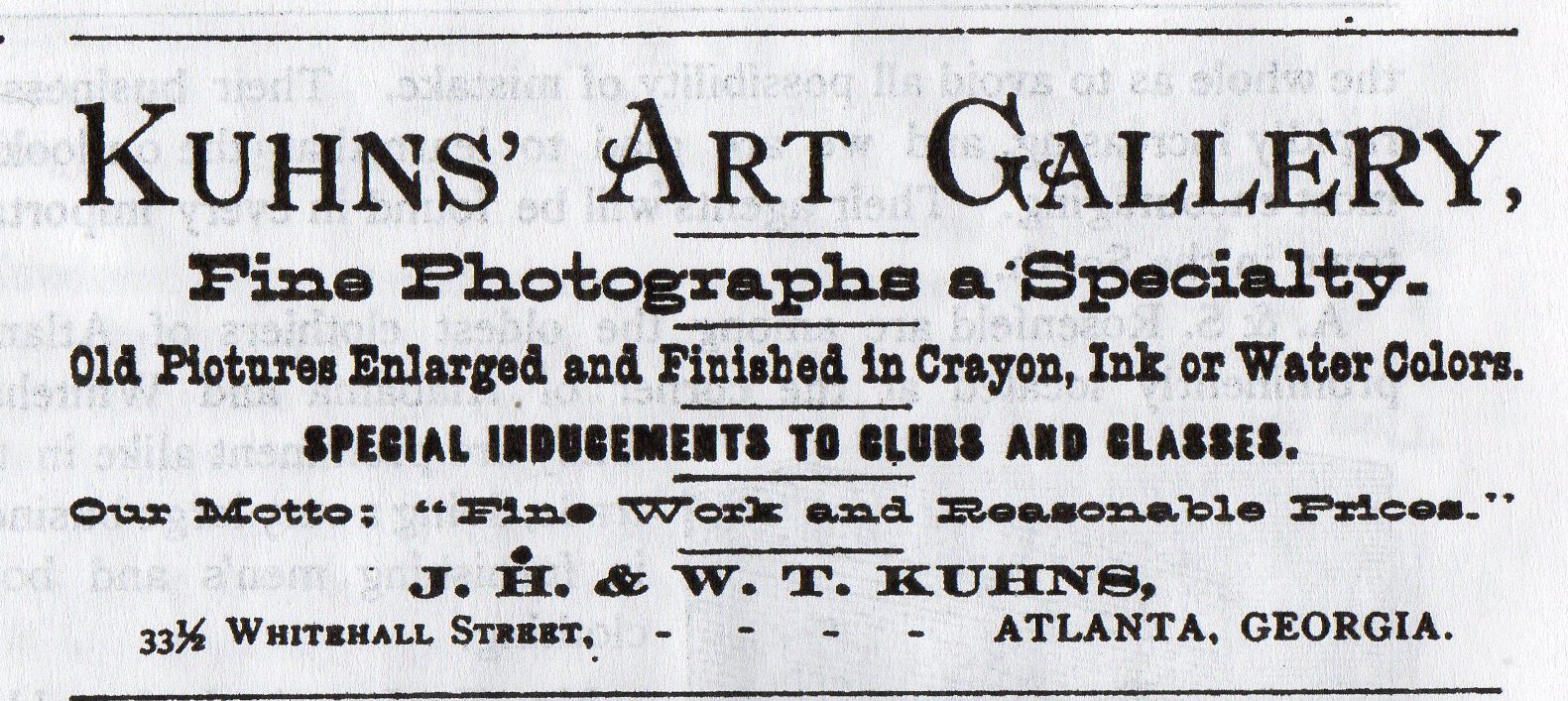
Illustrated Atlanta, published in 1881 (likely prepared in 1880), cites on page 144 “Kuhn & Sons’ Art Gallery, 33 1/2 Whitehall street “as “long established” and that they “make very fine pictures.” But in the advertisements section in that publication, on page XXXII (seen here), an ad for “Kuhns’ Art Gallery, Fine Photographs a Specialty,” cites J.H. & W.T Kuhns as running that business. As of 1881, their father William A. Kuhns, not yet sixty-years-old, gave the day-to-day running of the business to sons Julius H. and William T. Kuhns.
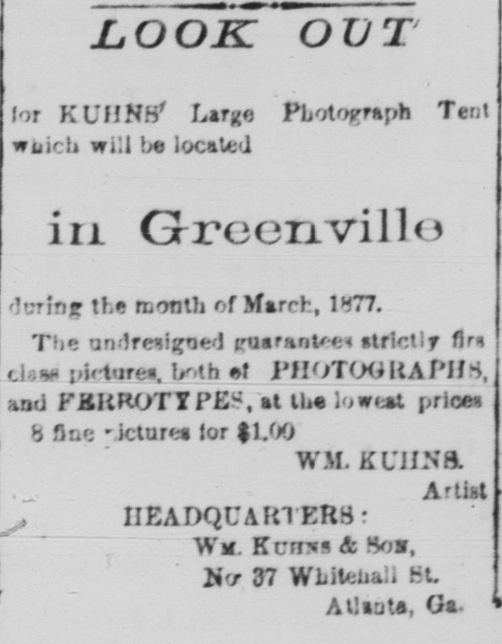
But William A. Kuhns did not stop working. As of 1876, after he made his son Julius a partner, he began to leave the big city occasionally to work in small Georgia cities and towns. In August 1876, he visited Acworth, just north of Atlanta, “with his tent” (Marietta Journal, August 11, 1876 p.3), and in March, and again in April 1877, he visited Greenville, south of Atlanta, to set up his tent. He advertised his Photographs and Ferrotypes in March, but in April he offered copying and enlarging old pictures, as well as making photographs. He signed these advertisements as “Artist,” on a separate line from “Wm. Kuhns & Son.” All work was to be printed from negatives sent to their “well arranged gallery in Atlanta.”
The Kuhns Art Gallery, Atlanta, now at their 33 1/2 Whitehall street location, placed an advertisement in The Christian Index of September 26, 1878, that ran through October. It simply stated that “We have the best light in the city, and are prepared to make first-class work. Give us a call.” An insert in a news section of The Christian Index of January 9, 1879 informed the “surviving relatives and friends of the late Elder James Reeves” could get a card photograph of him, for 25 cents “the actual cost,” from Kuhn & Son, or from a Reeves relative.

It was October 1886 before William Kuhns advertised in Greensboro (east of Atlanta and south of Athens) and that ad ran from 29 October until December when he announced his leaving about 12 December, probably to be home for Christmas. He advertised copying and enlarging and “well-executed likenesses” along with a schedule of prices. He promised to show a proof of the negative to customers, and if satisfied, they would pay 1/2 the price, with the other half to be paid when the finished photo came back from Kuhns’ gallery in Atlanta. This large and wordy advertisement was likely an expensive one to have printed.
In June 1887, Wm. Kuhns was advertising his “Instantaneous Photograph Gallery” north of Atlanta, in Clarksville, where he remained most of that month (The Courant American, advertisement in June 2 – 30, 1887). He made “2 ferrotypes for 50c,” as well as Panel Minnets, 12 for $1.50.
Another long advertisement signed Wm. Kuhns was published in The Conyers Weekly from November 30 through Dec. 21, 1887 (Dec. 21 is on p2c3). It too, had a schedule of prices with the same promise to show the customer a proof of the negative and send it to be finished by Kuhns Gallery, Atlanta. His son, Julius, worked in Conyers only a few years earlier, and I’ll write about him in my next “Kuhns” post.
In 1890, “Wilhelm Kühns,” born ca. 1824, departed Hamburg [Germany] on August 31, 1890, to return to New York on the ship Suevia, arriving in New York on September 13, 1890 (Morris, Photographers Traveling; NY Passenger Lists via Ancestry.com). After this trip, you would think William A. Kuhns was finished traveling. He was not.
By 1894, “Mr. Kuhns,” who was by then sixty-nine, now had a “photographic [train] car” which had to be “put into position” before he was ready to make photographs. He came to Vienna to work from early to mid-December (Vienna Progress, Dec. 4 – 18, 1894) in time for Christmas photos. He told his customers that getting a finished photograph back from Atlanta would take “8 to 12 days” (Vienna Progress, Dec. 18, 1894, pg. 5, col. 4). His son, William T. Kuhns, then located in nearby Albany, worked in Vienna in 1893 (Vienna Progress, Jan. 31 – 16 May, 1893). More about him in a future “Kuhns” post.
In early January 1895, he moved his car to Cordele. The Vienna Progress praised Wm. Kuhns to Cordele citizens, who would “please them as well as any Atlanta or New York photographer,” (Jan. 8, 1895, pg.3, col. 7). He returned to Vienna later that year, but he was ill that November, and advertised to “people of Vienna and Dooly County that “Mr. John Carter “well-known Conyers artist” would take his place and he would also send work to Atlanta’s Kuhns Gallery to be finished (Vienna Progress, Nov. 5 -19, 1895, pg.3).
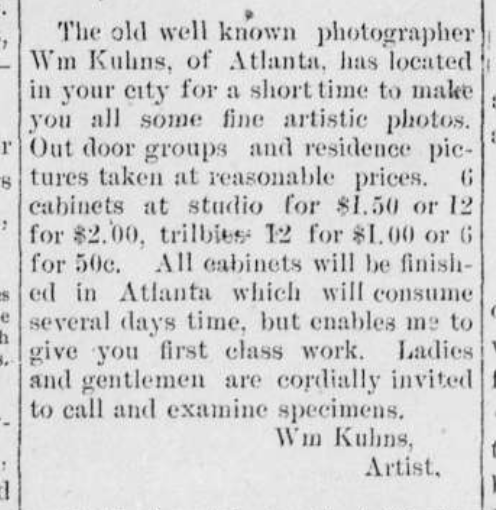
Although he was now into his 70s, he was working in “his tent” in Oglethorpe in the month of July 1898, referred to once as A. [August] Kuhns (Oglethorpe Echo, July 22-29, 1898 g.5, col. 1). It is definitely he advertising in Abbeville, in April 1899 (Abbeville Chronicle, April 6-27, 1899), offering outdoor groups and residence pictures, as well as cabinets and “trilbies”.
Now it appears he was finally finished traveling. He and Sophia are on the 1900 Federal Census in Dekalb County together with their adult children Henry, Charles, and Isabella, as well as Sophia’s niece, Mary Steinbeck. Sons Julius and Albert were both married before 1900.

In 1902, William and Sophia celebrated the 50th anniversary of their July 31, 1851 marriage, and all the children and grandchildren attended the celebrations held on the “broad veranda” at their home in Edgewood. They were “originally on Peachtree Street, later on Luckie, and now in Edgewood.” All the gifts were in gold coin to symbolize that anniversary. A few facts given in the August 3rd Atlanta Journal news article about the event are incorrect, but the account of the couple meeting during the four-month voyage to America, isn’t.
Upon his retirement, the business was not “run by a younger brother and son,” but by a son and his younger brother. A fun fact to know is that “Mr. Kuhns is now raising Belgian hares, for which he has a great fondness,” because one son, Henry, was well-known for his poultry. The article mentions that Sophia Kuhns continued to have a “pronounced brogue,” a heavy German accent to her English, but her husband had none, and the children and grandchildren never learned German.

Three years later, on October 29, 1905, William August Kuhns died at the Edgewood home at age 81. He was buried at Oakland Cemetery, in Atlanta, as were most of the family. His wife and their six children were still living. An obituary appeared in the Atlanta Constitution on Oct. 30, page 4, with the header “Death of William Kuhns,” in all caps, with a subhead of “Aged Pioneer Citizen Died Yesterday After Illness of a Few Days.” He was not “the oldest photographer in the state of Georgia,” but certainly among them. His pallbearers included Asa Candler. In 1908, his wife Sophia passed away, and three of her pallbearers, of six, had also been her husband’s (Atlanta Journal, February 20, 1908, pg.4). They are buried side-by-side, and their marker is beautiful, but unfortunately, three of their four carved dates are incorrect.
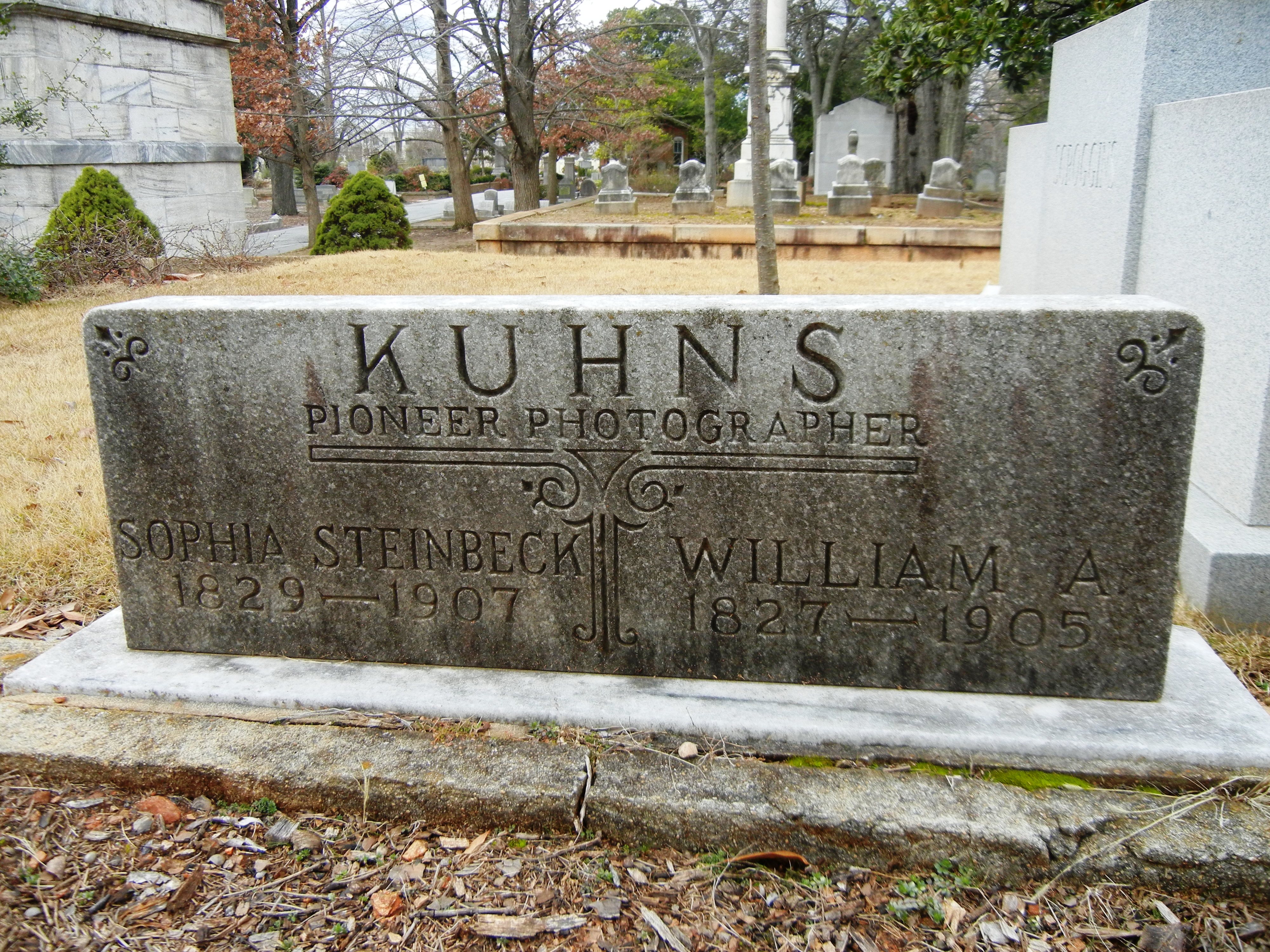
I hope this introduction to the patriarch of the Kuhns family of photographers whets your appetite for more, because there is so much more to tell. Enjoy your winter hunting and gathering information on your family, or others, and perhaps you will learn of some hidden photographers!
© E. Lee Eltzroth and Hunting & Gathering, 2025. Unauthorized use and/or duplication of this material, including photographs, without written permission from this blog’s author, is prohibited. With permission, excerpts and links may be used, provided that full and clear credit is given to E. Lee Eltzroth and Hunting & Gathering, with appropriate and specific direction to the original content.


 Hunting and Gathering