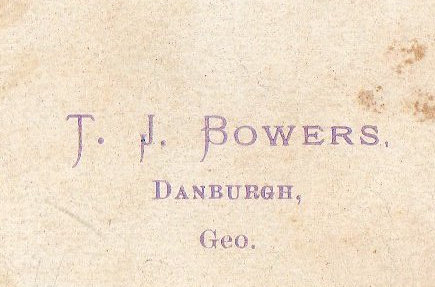
I have written about Thomas Jefferson Bowers (1839 -1894) before, in my post about Veteran Photographers, but I will expand upon that information.
According to his 1890 pension application, he was a captain in company C, 1st Georgia regiment, Frank’s Brigade. In that document he describes how he became deaf, stating that when he was on sentry duty in Augusta, Georgia, in February 1865, he “was taken suddenly with cerebral spinal meningitis,” and he lost consciousness, which resulted in his total deafness. Thus, Thomas Bowers was considered a disabled veteran.
He is listed in the Special Census on Deaf Family Marriages and Hearing Relatives, 1888-1895, which can now be searched online at Ancestry, in the collection “U.S. Special Census of Deaf Family Marriages and Hearing Relatives, 1888-1895.” The form Bowers filled out was coordinated by Gallaudet University, under the direction of Dr. E. A. Fay, who designed the questionnaire. Unfortunately, T. J. Bowers did not feel inclined to provide much information, likely because neither his wife or children was deaf and he was not born deaf.
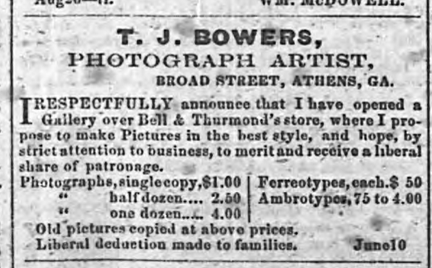
Bowers worked as a photographer in several Georgia cities. He worked in Athens (1868-1869), Rome (April 1870-1873), Elberton (1872, and briefly in 1873 and 1874), and the Hartwell area (c1873-1877), prior to his first listing in the Atlanta city directory in 1878. He worked in other cities, out of Atlanta, from 1878-1881.
Before the 1870 census was taken on June 9, he was already in Floyd County, and began advertising as of April 23, 1870, in the Rome Weekly Courier that he was prepared to make copies of “old pictures — made to look better than the original,” and his “prices [were] as low as possible.”
The census shows him living in Rome with his wife Mary and daughters Fannie and Ida. On July 8, 1870, the Weekly Courier editor noted that there was to be a Baby Show. “Mr. Bowers proposes to take a photograph of all the babies in Rome at 5 1/2 o’clock next Saturday evening.” Mothers were to bring their babies in carriages and gather in front of a local drug store. “We predict that it will be one of the prettiest exhibitions that has been in Rome lately.”
By September 1871, he and artist Edwin F. King (born about 1833) were partners, as Bowers & King. Their advertisement placed on September 2, 1871, in the Courier, states they had brought in W. A. Reckling “of S.C., a courteous gentleman and thorough artist” to make “the famous Berlin Heads, and Life-Size Portraits…”. In October that year, Bowers & King won awards at the Third Agricultural Fair for their photography, both for “Best photographs,” and for the “Best photograph of the Fair Grounds taken during the Fair” which would become Fair Association property (Weekly Courier, Oct. 20, 1871, pg.2, col. 4).
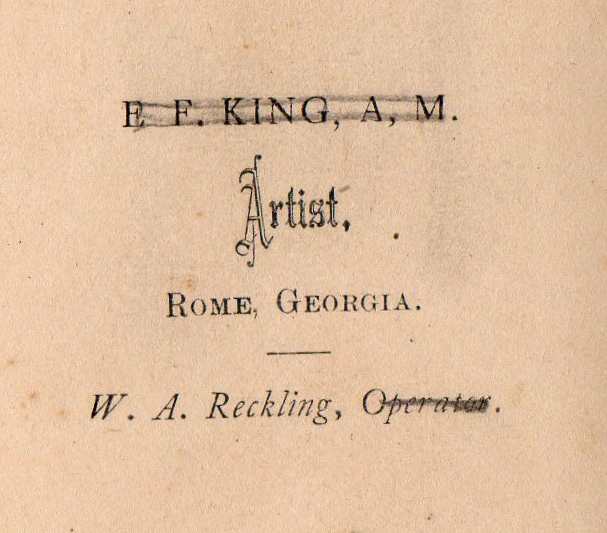
Their partnership was over by 1872, and Bowers moved to Elberton, but Edwin F. King, the artist, was still associated with William A. Reckling, the photographer. King’s advertisement in the October 29, 1872 Tri-Weekly, appeared into November though he was not there. His ad cited that “The present high reputation will be sustained….W. A. Reckling will be in charge during my occasional absences.” Sometime in October, King moved to Atlanta to take a job with Smith & Motes. He was with them only a few months when he began drinking heavily, and “Prof. King” died in his shared rooms of an accidental overdose of laudanum in early December. In a lengthy obituary in the Rome Tri-Weekly (Dec. 10, 1872, pg. 2, col. 3) he was described as “one of the most brilliant portrait artists in the South.”
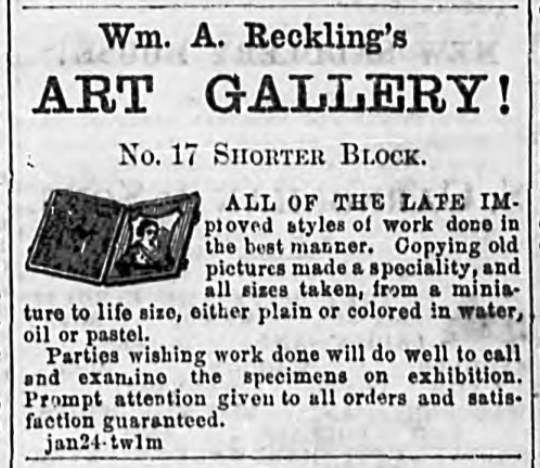
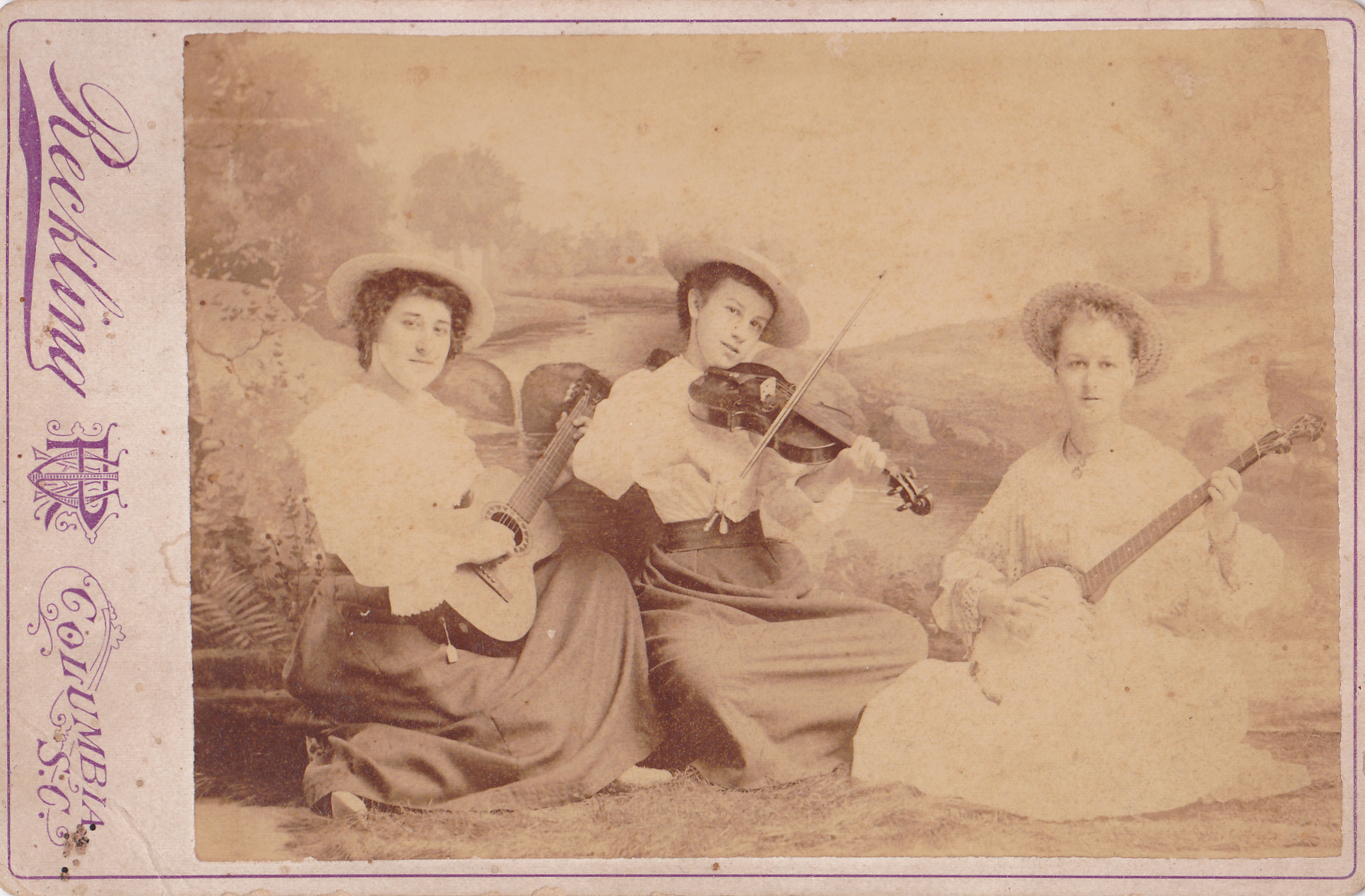
After King’s death, William A. Reckling (1849 – 1913) stayed in Rome to continue in the “Gallery of the late Professor King, in the Shorter Block,” and he began advertising his services just after King’s death, making “Rembrandt, Berlin-head, and Mezzotint pictures.” He remained at the no. 17 Shorter Block address through the winter of 1874, and he returned to Columbia, South Carolina, that spring. There he, eventually with his sons, worked as photographers for about forty years. He died in December 1913, and outlived both his former Rome, Georgia colleagues.
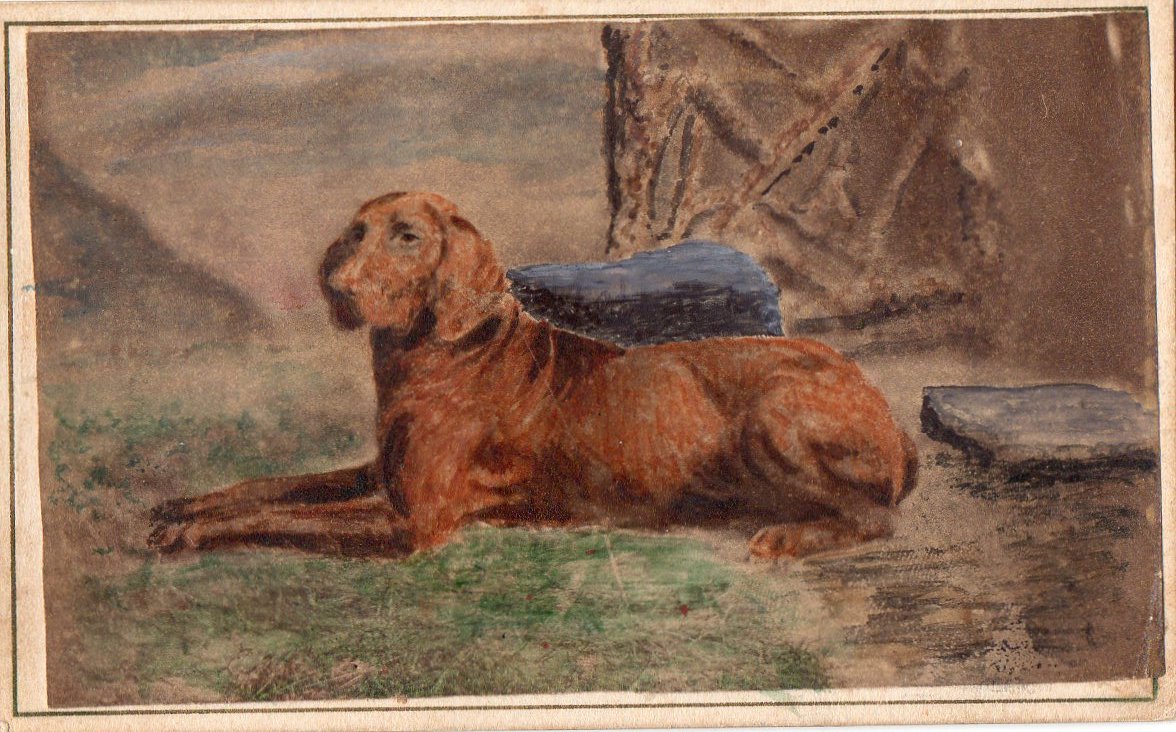
Bowers at one time worked in Danburg (aka Danburgh) where he made this interesting image of a dog. He is known to have been there in 1864, when he wrote a letter dated 25 Apr. 1864, accepting his commission as a captain, as well as the commissions of other men (in Georgia, U.S. Civil War Correspondence, found on ancestry). The letter makes me think this image may have been made earlier than I supposed, and it may date about the time Bowers decided to try out photography. He may have colored this image, but he may have been associated with an artist. The dog is highly colored and stylized, and the image is not square with the edge of the carte, and is off-kilter, suggesting an early attempt.
After leaving Rome in 1872, Bowers worked as a photographer in Elberton, the small city where he had married in 1859, and taught school and paid taxes in 1860 (1860 federal census record; Georgia – U.S. tax digests, 1860). It is perhaps this city where he was born and spent his childhood. By the end of that year, he sold his photograph gallery to H. [Henry] C. Edmunds (Elberton Gazette, January 22, 1873, pg. 4, col. 2), and in December 1873, T. J. Bowers came back to Elberton to work “for a few days for the purpose of taking pictures.” He was back again in October 1874, along with photographer A.E. Paxton, to work in “Dr. Edmunds’ Gallery from the 14th to the 24th of October” (Elberton Gazette, Dec. 3, 1873, pg. 2, col. 6; Gazette Oct. 21, 1874 pg. 4, col. 5).
Dr. Henry C. Edmunds (1834 – 1897) was definitely a physician, and also a war veteran, and he was involved in several ventures in Elberton. Not only did he have a drugstore when he purchased the photograph gallery above his drugstore in late 1873 (he apparently leased it to photographer John A. Wren, in spring 1875), but he was also a hotel proprietor by January 1874, and owned an Express [mail] Line to Washington [GA], which existed at least through the following autumn (Elberton Gazette advertisements, January – September 1874). By 1877, according to the Gazette, Edmunds bought most of the other businesses in town and was the proprietor of the grocery store, the tailoring shop, the tinware and repair shop (under his drugstore), the blacksmith’s, and the livery and stables.
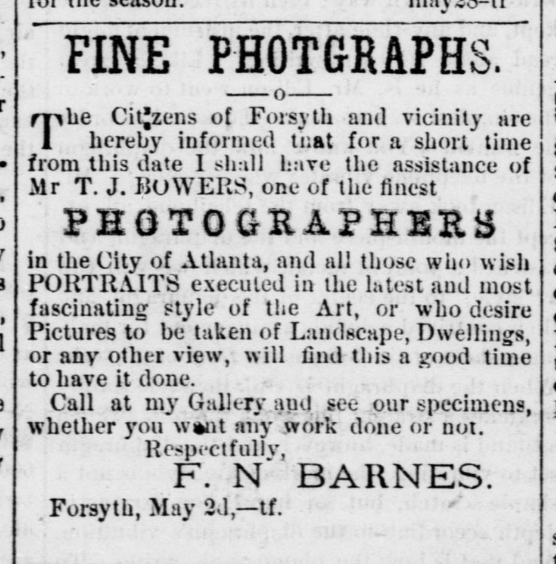
In May 1878, T. J. Bowers assisted at F. N. Barnes’s Forsyth photo gallery. Barnes called “Mr. T. J. Bowers, one of the finest photographers in the City of Atlanta….[for those who] wish portraits executed…., or who desire Pictures to be taken of Landscape, Dwellings, or any other view, will find this a good time to have it done.”
Fred N. Barnes apparently opened his photo studio in Forsyth, in fall 1875 (Monroe Advertiser, 12 October 1875 pg. 2, col. 2, ran Oct. 5 – Nov. 23). A few months before T. J. Bowers arrived to assist him, Barnes advertised on March 26, 1878, that “Owing to declining health” he was offering his entire photography set-up “at one half cost price, together with all instructions in the art gratis.” (Monroe Advertiser, pg.3, col. 4). He obviously kept the studio, but I find no advertisement for it after 1878. He owned other businesses in Forsyth, including a goods store by 1876, in which a bakery opened in early 1878, so it seems the photo studio was not his sole means of support.
In Atlanta by 1878, T. J. Bowers was a partner to S. [Shadrach] H. Speairs (1860-1880) in Bowers & Speairs. They are documented by the National Stereoscopic Association as taking stereo views, one cited in particular is of a mass baptizing in a rock quarry, although I have never seen this. Speiars passed away in August 1880, and Bowers continued to work alone at the same address, 179 Marietta Street. He was recorded at that location in the 1879 and 1880 city directories, and not until about 1885, did he change locations. He is included in the Atlanta city directories through 1885, and he worked in Atlanta on and off during that time, renting his studio from about 1880 to 1883, to photographer J.W. Perkins (ca.1828 – 1898). Bowers continued to travel and work elsewhere, using his photographic “tent” to set up temporary studios.
In January 1880, he was in his tent studio in Hampton, in Henry County, stating that his photographs would be “retouched and finished in Atlanta, and by this means can produce as fine pictures as Atlanta artists.” In June 1881, he took his tent studio to Greensboro, where the local newspaper stated he “visited this place about ten years ago,” so he was possibly there about 1871. While in Hampton he also took his Tent to White Plains, whose citizens found him “a good Artist, a quiet intelligent gentleman, and in every way worthy of the confidence of the Plains people” (Henry County Weekly, Jan. 23, 1880, pg. 3, col. 2; Greensboro Herald, June 9, 1881, pg. 3, co. 4-5).
It was on October 22, 1878, that the Atlanta City Council recorded a petition of T. J. Bowers, “to be allowed to conduct a photograph gallery free of license.” The petition was “Referred to the committee on tax” (Atlanta Constitution, Oct. 22, 1878, pg. 4, col. 2). We can assume the petition was placed by Bowers as a disabled veteran. It would be several years before the Georgia legislature would pass a bill in 1892 “to allow disabled Confederate soldiers to run photograph galleries free of license.” By 1899, all Confederate soldiers would be free of of the tax on photographers.
When working in Atlanta, Bowers wife assisted him in reception, and his daughter Fannie worked in the studio a few years before her marriage to R. B. Rogers. Their wedding was conducted in October 1882, by the father of Bowers’ former partner, Rev. W. J. Speairs. Fannie then moved with her husband to his Alabama home.
In February 1890, T. J. Bowers’s application for a pension, filed in Atlanta, was accepted and he was awarded $30 for the year ending October 24, 1890. By 1891, Bowers and his wife, Mary, joined their married daughter, Effie Bowers Rogers, in Alabama. About four years later, on March 16, 1894, Thomas J. Bowers died from injuries he received when he was struck by an “East Lake dummy engine” of the Birmingham Railway & Electric Company, as he was crossing the track. The Atlanta Constitution (March 16, 1894, pg. 2, col. 3) in an article about Birmingham, said that Bowers “transferred the mail between Birmingham and East Lake,” and that is why he was struck by the train right there. He was incorrectly described in the Atlanta article and by The Birmingham News (March 16, 1894, pg. 6) and other Birmingham newspapers, as “deaf and dumb” although he was certainly able to speak and capably ran a photography business for many years.
After her husband’s death Mary Bowers brought a “suit against the Birmingham Railway and Electric Company for $5,000 in damages,” in September 1894. It was stated that T. J. Bowers was deaf, and “did not see or hear the train, and the engineer could not stop in time…” On January 26, 1895, a jury in the City Court “agreed late in the night to give judgement for the plaintiff for $100.” Mary Bowers did not think this was adequate, but nothing changed. (Birmingham Age-Herald, September 21, 1894, pg. 5; Birmingham Post Herald, January 27, 1895 pg. 3, col. 5).
Mary Bowers died three years later. Both she and Thomas Bowers are buried in Birmingham’s East Lake Cemetery.
This peripatetic photographer and the interesting associates he made in his twenty-five year career fascinates me, but there is still more to learn about all of them. Every life is interesting, and sometimes events of that life are happy ones, and sometimes rather sad, but they always tell us a story, allowing us to put a few more pieces into the quilt of Georgia photographers.
© E. Lee Eltzroth and Hunting & Gathering, 2024. Unauthorized use and/or duplication of this material, including photographs from her collection, without written permission from this blog’s author is prohibited. The piece can be re-blogged, and excerpts and links may be used, provided that full and clear credit is given to E. Lee Eltzroth and Hunting & Gathering, with appropriate and specific direction to the original content.


 Hunting and Gathering
Any Alabama work?
Hope you got my email, not working there as a photographer, think he’d retired once they moved to AL to be close to daughter.
Thanks. My grandfather on my my mother’s side began portrait work in Tuscaloosa Alabama around 1910. Ill health forced him to move north in Alabama and while we have some nice photographs that in made of family in north Alabama, my impression is that he abandoned the studio effort. None of the board-mounted pictures that have come down bear a studio name. He was W.T. Daffron, William Thomas, or just Will. I have a few images that show studio equipment. I have wondered how a man of little means set himself in the photography business early in the century. I am guessing that you could buy equipment and lessons from the same place though where that might have been I have no idea. Might have been mail order. I keep meaning to post some of his work. I have posted one. Little daughter Beatrice (born 1914). It was made in Vinemont, Cullman County. I also have an informal picture of the kids (7 in all) flocking in a rye field in Berlin Alabama, not too far from Vinemont. You can see my one published image at https://wellsweptyard.blogspot.com/ It is the second item on the first (last) page.
Have you looked at “Shot in Alabama” by Frances Robb, re AL photographers? See if your library has it.
I looked. No luck. Wonder if it is streaming
Found something on YouTube. Not sure is it is complete. https://youtu.be/5P4hNWhMmTw?si=4tQGN45P5ecSlXWd
Have been doing Ancestry research. My great great gf was named Thomas Jefferson Bowers. He lived in the Dahlonega/Gainesville area of GA, not far from Athens. Pretty sure the photographer you reference was not my relative, as he was listed as a farmer on the census. But wondering if there was a family relationship of some kind. Curious since I have an interest in photography as well. Any further details about T J Bowers along those lines would be appreciated.
Thanks for reading. I will get back to you when I can, perhaps later this week and from another email address.
Thank you. My email is andyo51@yahoo.com.